

Gentle reader,
We started telling offbeat Los Angeles stories in 2005, with a true crime blog called 1947project—a crime a day revisited on the day it happened, bookended by visits to the crime scenes to see how they had changed in 58 years.
Kim wrote up the tales and preservation pal Nathan Marsak put in the miles exploring then and now.
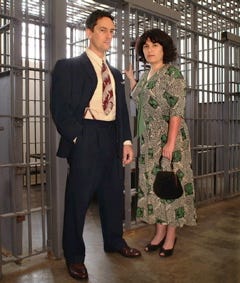
Here’s an L.A. Times interview about the new blog. Soon after, we started giving guided tours, because readers demanded them. The rest is history.
But history is scarce in a news desert, and Los Angeles is nearly bone-dry.
There would have been no 1947project and no Esotouric without the shoe-leather news hounds who turned everyday trouble into compelling narratives. All the stories we dug up and spun anew were originally reported by sharp, observant, hustling reporters and their photojournalist sidekicks.

And for the first few years, our research was laboriously hands-on: in public libraries, perched before unpleasantly warm microfilm readers, scrolling through fuzzy black-and-white in search of gold nuggets.
If we think we know what it felt like to witness some remarkable event in the past, it’s thanks to these often anonymous tradesmen and women, and to the professionally friendly relationships they maintained with cops, clerks, political staffers, lunch counter operators, restroom monitors, bartenders, bus drivers, theater ushers and thousands of other ordinary Angelenos who were out and about with their eyes open, ready to serve as a quoted eyewitness or paid-off tipster when deadlines called.
For it was in every Angeleno’s interest that life not scroll by without notice, that if blood was shed the whole city could stop, look at the stain and pay the victim the respect of being worthy of a few column inches.
No more.
We still have a history, a present, and a future. Terrible, wonderful, incredible things happen in Los Angeles every day.
But unless things change an awful lot, there will be no 2027project blog and no scrappy guided-tour operation launched in 2085. The rich tapestry of 21st century material simply isn’t there. Local lives will continue to unfurl and end without notice—including some lives and deaths so interesting that 20th century editors would have stopped the presses to make sure the whole town knew—but you won’t know it, or them.
What a pity to have no civic record. Yet we have to somehow navigate what it is to be an Angeleno without one. This means that big things can happen entirely in the dark, and those of us who have the time and inclination need to step in and report the news that the missing professionals miss.
Like this: one afternoon in mid-July, a young man passed through security and got a visitor’s sticker, ascended via the double elevator system and jumped to his death from the upper floors of Los Angeles City Hall.
This tragic incident was reported, but not what soon and directly followed: the City quietly closed the top of the building, comprising the Observation Tower, Tom Bradley Room and the hall of Mayoral portraits, to all but special events organized by public officials.
And these normally public spaces remained closed through the summer.
Tourist guides have been recommending the Observation Tower as a must-see, free attraction for a century. In the first few years, you would even find a real native son at the top who could interpret the view and tell you about the dusty pueblo that had grown up on his watch.
A building this tall was a novelty to many of the 800 to 1000 daily visitors in 1928, and often Charles J. Prudhomme would have to coax a frightened guest out onto the patio to hear his lecture on the old pueblo days. He and a helper were also alert to keep wise guys from seeing how high a tennis ball might bounce off of Spring Street and to look out for signs of despondency.

But after “Don Carlos” Prudhomme died in 1934, nobody took his place as the in-house historian, an official post which the city termed Custodian of the Tower. For nearly a century, it has been an unmanned tourist attraction.

Still, the self-guided views are spectacular. From the east walking counter-clockwise, you’ll spy Boyle Heights and the L.A. River, Olvera Street and Pico House, Grand Park and the DWP, the Palos Verdes Peninsula and, on a clear day, Catalina.
Thousands of tourists must have been turned away at the Main Street security desk between late July and early October. But it seems that we’re the only reporters who noticed some of them being refused access and tried to get answers about the reason for the tower closure and how long it might last.
We have sought answers from the Office of Historic Resources, Project Restore, City Hall security and the Mayor’s Office. The responses we got were polite, but vague—just that the closure was in response to the tragedy in July, and that no historic features would be impacted by the changes being made—but because we’d been asking them, we were alerted when the tower reopened in early October.
When we visited, there were quite a few tourists enjoying the view and the quiet, pretty room to sit and plan the next bit of their day in Los Angeles. All that was missing was a Don Carlos, a gregarious local who could welcome friends new and old and be the face of a city that can seem very big and lonely.
Had a Los Angeles ambassador been stationed in the tower, maybe things might have gone differently for the young man who felt so hopeless. We can’t know, but we do believe that it can only make things better to have more caring people paying attention inside the powerful and perplexing landmark City Hall.
Ever since the spring, when we viewed Don Carlos’ fascinating collection of photographs produced for the Historical Society of Southern California which are held in the Huntington Library, we’ve felt a kinship with this native Angeleno who spent his last days rushing from one pending demolition site to the next, capturing the obsolete structures that had been a part of his youth, but that had no place in a booming metropolis.
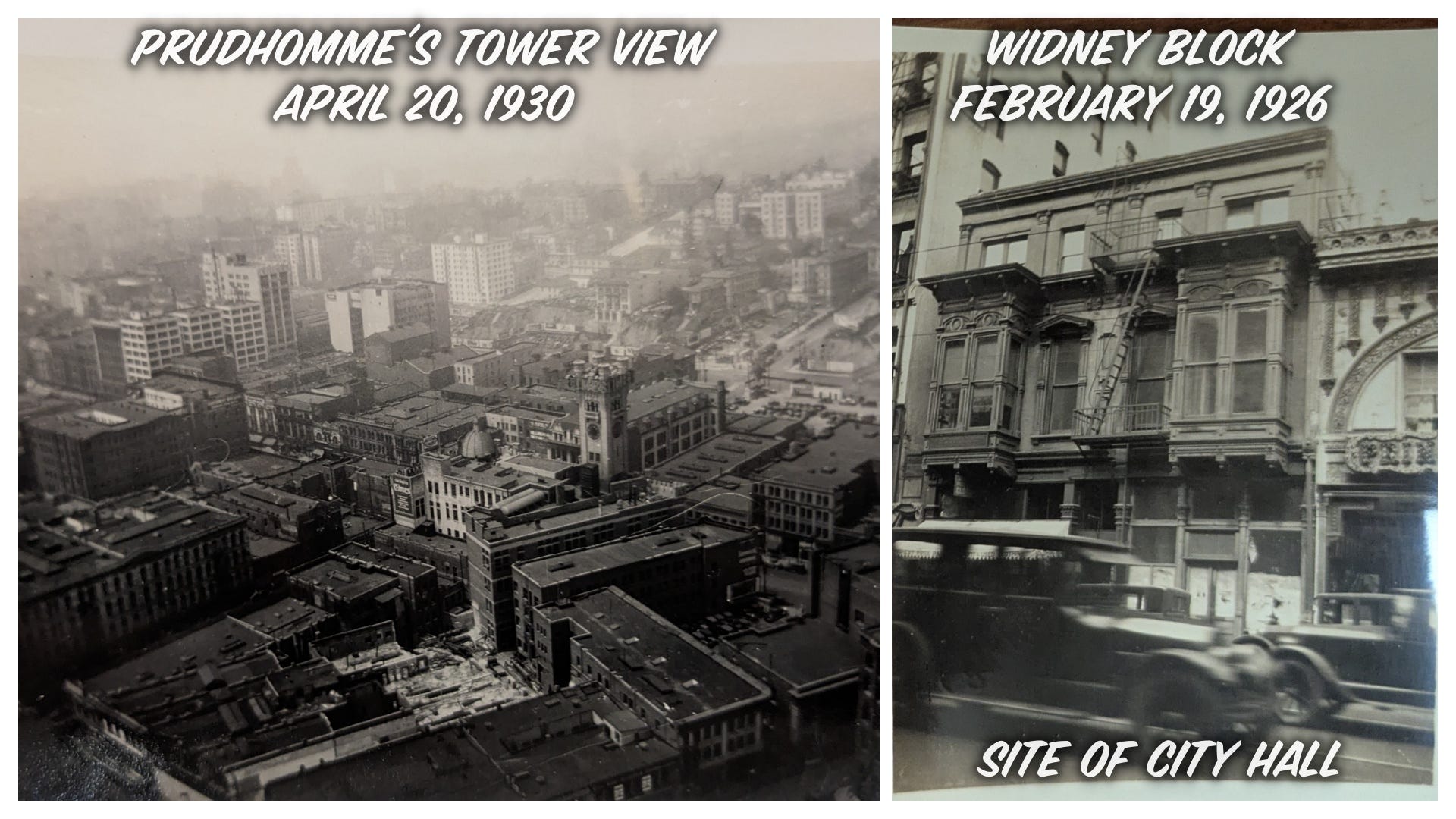
Imagine him up there, scouting the horizon for wrecking crews, descending to document another bitter loss, then returning to his post to greet the next visitor.

It seems wrong that you can ascend City Hall, view a portrait of every rogue and mensch who ever swore allegiance as mayor, yet old Don Carlos Prudhomme is not on display. His portrait, by renowned California artist Orpha Klinker Carpenter, was gifted to the City to be hung above his old tower desk in 1935.

The portrait may be misplaced in storage—though as of 2000, when a Civic Art Collection assessment was undertaken, the Department of Cultural Affairs marked it as missing—but there are many wonderful photographic portraits to choose from, and we think it’s high time his picture went back on the wall.
Better still, why not revive the role of City Hall historian and civic ambassador in his honor? We can think of many qualified L.A. lovers who would be perfect to fill those pioneer boots and welcome the world as the Olympics approach.
If Tom LaBonge, who gets a shout-out in this video, were still around, we’d make an appointment and pitch this idea to him. We didn’t always agree with the councilmember, but greatly appreciated his willingness to make time to talk with Angelenos, to consider their big and small ideas, to frankly answer whether there was any hope and to share a passion for improving Los Angeles through teamwork that is sorely lacking among the current crew in power.
But he’s gone, so all we can do is send this little message out and hope it lands. We’re sorry we have to do the work of the City Hall reporters who once treated the building like their home, but honored to carry on their efforts.
It matters that a young life was lost this summer and that the tower was closed for months in response, to make the landmark safer and keep it accessible to all. It isn’t right that the closure should go unnoticed as it has.
We’ll probably visit the tower tomorrow morning, during a break from the special Cultural Heritage Commission hearing, which starts at 9 a.m. You can participate in person, or by calling or Zooming in, and the agenda is packed with interesting preservation problems.
The meeting begins with a tribute to Richard Barron from his longtime commission colleagues. Barron’s last act of official advocacy was to say hell no to fencing MacArthur Park, and after 22 years of service, the CHC feels unfamiliar without his presence on the dais.
Item 4 - The Barry Building (11973–11975 W. San Vicente Blvd., Brentwood) The Commission will decide whether to maintain its objection to demolition of the landmark, ostensibly for no new project, to withdraw the objection or extend the stay to allow more time to find a preservation solution. The property owner has offered the former Dutton’s Books for $1 for anyone willing to move it offsite, but won’t entertain offers to buy both the building and the land. Learn more here.
Item 5. Original Pantry (873–877 S. Figueroa St., Downtown) A second informational presentation on a poorly-received proposal to install digital ads on the roof of the historic cafe. Mayor Richard Riordan famously sold off the air rights to protect it, so roof signs are a question mark. Learn more here.

Item 6. Pacific’s Cinerama Dome Theatre and Marquee (6360–6368 W. Sunset Blvd., Hollywood) An informational presentation on the proposed rehabilitation of the landmark theater for new operators Alamo Drafthouse.
Item 7. Dynasty Center (800–816 N. Broadway et al., Chinatown) The CHC considers whether to take under consideration an application to declare the community flea market as an Historic-Cultural Monument on cultural grounds. Property owners Redcar object. The community is rightly concerned about vacant retail, rising rents and gentrification, and we expect this to be heated.
Item 8. Canyon Country Store (2100–2108 N. Laurel Canyon Blvd., Hollywood Hills) The CHC considers whether to take under consideration an application to designate the Laurel Canyon music scene landmark as an official monument.
Item 9. Park La Brea (large residential complex between LACMA and the Original Farmer’s Market, Mid-Wilshire) The CHC considers whether Park La Brea qualifies as a monument. The proposed designation also requires a determination of categorical exemption under CEQA.
There’s likely one or more matters you hold dear on this agenda, so why not tune in virtually or join us at City Hall and have your say?
The heat finally broke, which means Saturday’s tour is going to be a pleasant stroll into the past. It’s nearly Hallowe’en and on our Highland Park Arroyo Time Travel Trip we’ll be visiting some enchanted landmarks, including Lummis House and Heritage Square, and honoring folk art maestro Florencio Morales and his divinely-inspired yard decor, so beautifully documented by Amy V. Kitchener. This tour takes you inside some special houses, too! Join us, do!
Yours for Los Angeles,
Kim & Richard
Esotouric
Are you on social media? We’re on Instagram, Twitter, Facebook, YouTube, Mastodon, Threads, Bluesky, Substack Notes, TikTok, Nextdoor and Reddit sharing preservation news as it happens.
Our work—leading tours and historic preservation and cultural landmark advocacy—is about building a bridge between Los Angeles’ past and its future, and not allowing the corrupt, greedy, inept and misguided players who hold present power to destroy the city’s soul and body. If you’d like to support our efforts to be the voice of places worth preserving, we have a tip jar, vintage Los Angeles webinars available to stream, in-person tours and a souvenir shop you can browse in. We’ve also got recommended reading bookshelves on Amazon and the Bookshop indie bookstore site. And did you know we offer private versions of our walking tours for groups big or small? Or just share this link with other people who care.
UPCOMING WALKING TOURS
• Highland Park Arroyo Time Travel Trip (10/17) • Film Noir / Real Noir (10/24) • Hallowe’en at Evergreen Cemetery, 1877 (10/31) • The Real Black Dahlia (11/7) • Richard’s Birthday Weird West Adams Tour & Elmer McCurdy Museum Visit (11/14) • Angelino Heights & Carroll Avenue (11/21) • Hollywood Noir (11/28) • Know Your Downtown Los Angeles (12/19) • Miracle Mile Marvels & Madness (Sun. 12/20) • Human Sacrifice: The Black Dahlia, Elisa Lam, Heidi Planck & Skid Row Slasher Cases (12/26) • The Real Black Dahlia (1/16) • Angelino Heights & Carroll Avenue (1/23) • Evergreen Cemetery, 1877 (1/30)

CLOSELY WATCHED TRAINS


Judge Percy “No Mercy” Anderson just threw out the Marilyn Monroe house owners’ federal lawsuit against the City of Los Angeles. He disagrees that the Brentwood landmark is essentially worthless, doesn’t accept the claim that the City encouraged trespassing, and notes that the owners could have predicted opposition to demolishing this world-famous residence. Next stop: the 9th Circuit Court of Appeals.

Six years after a deceptive redevelopment project marked The Silver Platter for demolition, the historic gay bar is safe! City Planning: “For whatever reason the permits were not issued. It appears the developer just stopped working on this project.” What now?

When The Penguin by Googie masters Armét & Davis was listed for sale last year, the Santa Monica and Los Angeles Conservancies initiated a landmark nomination. It squeaked in just before a demo application. Can the end of Route 66 stay cool? Stay tuned!
GASP! A.F. Gilmore Company, the family office that developed and maintains the Original Farmer’s Market, has purchased the landmarked Fairfax Theatre facade and the land inside it for a very fair $7.2 million. They recently bought the surface parking lot to the north, too. Gilmore understands heritage, good design and community-serving development, and we’re excited and hopeful to see what they have planned. This is very happy news for the Fairfax and for Art Deco in Los Angeles!

Our cure and correct demand for a proper hearing on removing the name of WWI memorial Pershing Square has hit the council file. Why do we do this and not accept City Hall’s politically expedient take on history? Because L.A.’s ghosts are citizens, too.
We stopped by Signmakers in historic South Central to see the test cans for the restored Earl Carroll Theatre signage—thrilling! But our joy bubble got popped when we saw the demolition notices down the block. Such sweet Edwardian cottages (and kittens)—paging Altadena—save them!
The Hotel Cecil’s own in-house chaplain Rev. Dylan Littlefield reflects on what he’s learned in the two years since he became a bishop (learn names! bring snacks!) and on the prayers and intentions of Angeleno communities he is taking to Assisi this week.
NoHo Noir! Lourine was a special bungalow court of Craftsman cottages shaded by evergreens. L.A. let units be held vacant and blighted, then the evil landlord hired an arsonist to clear the remaining tenants out. After all that, the City green-lit eviction and demolition. Sick city.
Cheers to Juntos Florence-Firestone Together, who told the County how much the Florence Car Wash meant to their community—and to Regional Planning for listening. Instead of destroying the sign and fins, these retro relics live on as the face of a dense new apartment complex.

In December, preservation pals will gather to repaint and restore Chinatown’s Seven Star Cavern Wishing Well (1938), in honor of creator Professor Henry Liu Hong Kay and longtime caretaker Jody Hummer. Throw a little something in the pot if you are able!
Marialyce Pedersen, who lost her Altadena home in the Eaton Fire, addresses the Board of Supervisors on the FSRI report, calling for Chief Marrone to be fired or charged with manslaughter for dereliction of duty in West Altadena.
The happiest place in Los Angeles will soon be the northwest corner of Sunset and Alvarado: Burrito King is reopening! Preservation pal Damian Sullivan met Yanina and Armando to hear about how they’ll honor the stall’s history with original menu items and love. Sign up for opening info or follow on Instagram.

Nathan Marsak is probably the biggest Hotel Clark nut on the planet, and his blog post celebrating its reopening after decades of darkness is exactly as giddy as you’d expect. He takes us inside—and shows off his huge Clarkiana collection, too!
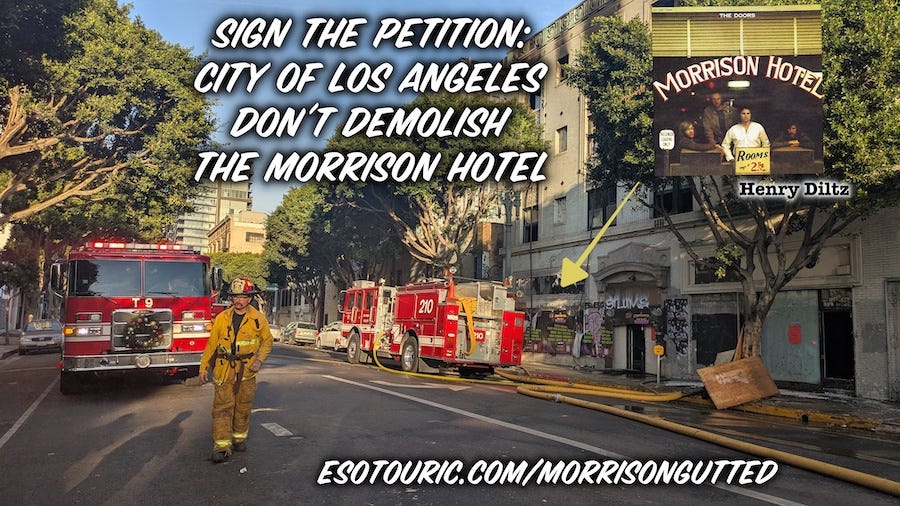
Morrison Hotel owners sue to stop Los Angeles from declaring it a nuisance, which makes our petition timely again. Please sign and share. The old gal has a lot of life left in her, and we hate that she was gutted with no permits to stop a landmark nomination from being heard.

Bittersweet audio piece by modern-day Bunker Hill resident Lisa Napoli about the last children to live in that Victorian paradise before the bulldozers chewed it up and LAPL’s hoard of unpublished Leo Politi views of their happy life—and favorite cat!

The National Trust, through its L.A. Women’s Landmarks Project, has nominated the Etta James Residence—adorable outside, but de-souled by flippers in 2022—as a landmark for its cultural association with a great South Los Angeles diva.
Here’s the Skid Row raid criminal complaint. See page 35: a Pasadena house is surveilled. A resident there allegedly has a key to an SRO unit, but does not sleep there. LAHSA is responsible for CES/PSH voucher leases. That’s why HUD’s OIG is involved.
Learn more about Skid Row’s history and the kind of people who lived and played here on our YouTube playlist, including several early 2010s history walks between City Hall and the Union Rescue Mission with Rev. Andy Bales, above.
For defendant Manuel Vaughns, GPS cell-site tracking showed he lived in West Covina. Yet management confirmed he maintained a lease for Unit 418 at 625 S. San Pedro St., Skid Row Housing Trust’s Abbey Apartments, a newly built SRO which was mismanaged and fell into receivership.
When Skid Row Housing Trust went bust after the state restricted its borrowing for displacing tenants to demolish existing SROs and weird board schemes like growing weed and selling junk mortgages, the LA Times ran cover. Dirty tenants were the problem.
Now one of the former Skid Row Housing Trust SROs, built with your money to provide safe housing for vulnerable people coming back from the traumas of homelessness, is alleged to be a stash house for drug dealers who commute to work on the block. Everybody has failed Skid Row.
Defendant Rodney “Jamaica” Thomas slept in an apartment by Park La Brea. Yet DMV records and LAPD surveillance revealed he also had a keycard and lease to unit 425 in the same former SRHT SRO as defendant Manuel Vaughns. Scarce LAHSA units used for crime, not for housing?
The complaint alleges that these SRO units were used to store large quantities of drugs so the dealers wouldn’t have to carry contraband while commuting from the nice neighborhoods where they lived to the desperately poor and troubled block where they did business.
How scary would it be, to survive homelessness, finally get a voucher and be placed in an SRO unit, then realize that some of your neighbors were running drugs out of rooms where they don’t live. How do you stay sober? Who do you complain to? Is there anyone you can trust?
There’s a lot of blame to go around. But what’s missing in Los Angeles, the thing that disappeared before this city ran completely off the rails, is a widely read, trustworthy, dogged newspaper. Blame the Chandlers for selling and Patrick Soon-Shiong for holding the L.A. Times.

Los Angeles is so profoundly broken we might as well ask the dead what to do.
Kevin Starr’s 2002 proposal for locally elected boroughs has been revived in Council File 26-1382, introduced by Tim McOsker, who was Mayor Jim Hahn’s Chief of Staff when this bright idea dimmed in 2002.
Starr’s answer to a growing secession movement was to respect citizens who sought local control and give it to them—to Federate LA.
His diagnosis of neighborhood councils was tough but fair: “government as therapy.” Feel-good busywork, no governing power. (Today, City Hall ignores the NCs—Rec and Parks didn’t even show up to present on fencing MacArthur Park.)
Starr said: let neighborhoods govern themselves, let boroughs handle regional matters and restrict City Hall power only to issues requiring citywide governance.
Had this happened in 2002, the multi-pronged collapse of Los Angeles could have been averted, with local problems solved by the neighbors most impacted before they became too entrenched—and too profitable—for the political machine to fix.
Neighborhoods wrecked by greed and mismanagement would still be intact. And our landmarks wouldn’t be treated like garbage instead of the priceless cultural heritage and communal spaces that define us as Angelenos.
Think of all that might not be lost if the people had the power: The Ambassador Hotel, Taix, Hollywood Center Motel, Pacific Dining Car, the Fairfax Theatre, lovely Lytton Savings at Sunset and Crescent Heights.
Parker Center could be affordable workforce housing with a world-class museum of forensic science history. The Triforium would be alive nightly with music and sparkling lights. Broadway would still be a thriving shopping district, Hollywood Boulevard, too.
You could dine on early Californio chili dishes in the courtyard of the Southwest Museum to the songs of old L.A. The ponies at the Griffith Park Pony Rides would still be trotting along. Olvera Street would be the hottest spot in a hot town.
Angelenos would be excited about the Olympics, not gritting their teeth and dreading the costs and security risks.
Imagine a City Hall without elected officials controlling the purse strings to manage astroturf cultural events that should be independently produced by Angelenos fostering positive public space and supporting each other.
Starr’s proposal was for a bullseye of power: neighborhood councils meet and confer, then federate into boroughs of elected local leaders with real power. Boroughs do community governance while City Hall runs the port, airport, LAPD, LAFD, water, power, roads, parks, libraries.
The most valuable resource in Los Angeles is passionate, invested, creative Angelenos who want to make things better. City Hall wants nothing to do with them—unless they kiss the rings of the idiots who got us into this mess.
Screw that and them and their smelly rings.
This is a fascinating twist in the civic saga, revived by a councilmember who actually serves his CD15 community, filtered through the stilled mind of Kevin Starr, who seems to have seen the future when he wrote in 2002:
“Federation, in fact, can be seen as the primary mode of effective post-modernist governance. Part of the reason for this resides, I believe, in information theory and practice. The digital revolution has tended to make each person his or her own information base. Each of us, in fact, are becoming more autonomous because we are the stewards, through digital technology, of a personally tailored information system.”
Sign up to track the motion or submit your own comments here. Read Kevin Starr’s 2002 op-ed, added to the public record by civic reformer and budget hawk Jack Humphreville, here.
Federation, si! Deconstruction, no! Why the hell not?


