

Gentle reader,
They grow up so fast!
It was just a few years ago that we poked and pestered until we gained access to the gated Chevron Oil fee strip in Compton.
This was where an enormous native sycamore called the Eagle Tree, famous as a map marker between Spanish-era rancho land grants, lived for centuries before being struck by lightning and toppling over into the apartment parking lot next door.

In the shadow of the hollow, dying mother tree, a many-trunked clone was already filling out, eager to grow to great size over the next four hundred years.
But Chevron, which drove its thirsty wells into California when the Eagle Tree was already mature, decided—landmark or not—that it shouldn’t stay and cause any more bother.
That’s when we kicked our advocacy efforts into a high, new gear.
No longer just asking that Compton and Chevron dedicate resources to stewarding the famous tree and provide occasional public access to the historic marker, it was now a race against time to gather biological material and find botanical partners willing to foster cuttings until they were viable and could go into the ground.
With pesky preservation pal Dr. Don Hodel by our side, those partnerships were quickly forged. Fresh twigs from the Eagle Tree were wrapped in wet towels, carried away in an ice chest, then placed in the care of the Huntington Gardens, the California Botanical Garden and the Theodore Payne Foundation.
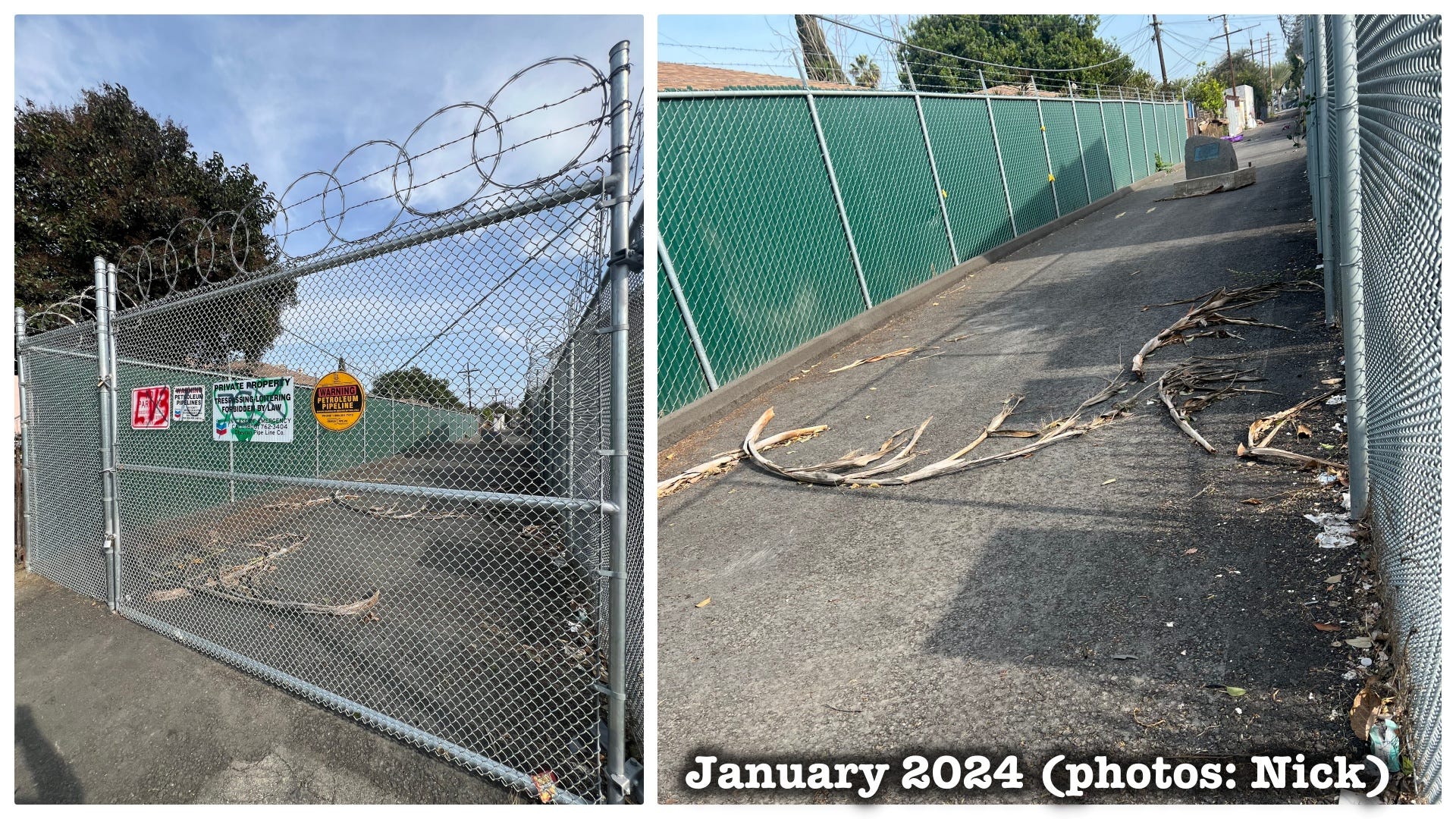
And then, with no notice to historians or botanists, Chevron installed tall, razor wire fences, removed the young Eagle Tree and paved the entire fee strip. In an instant, an urban meadow alive with tiny creatures and a landscape that still suggested a time without internal combustion engines was no more.
But happily, the Eagle Tree’s story doesn’t end there. Because at the Huntington Gardens, where we’d delivered dozens of twigs into the hands of the botanists, senior staff were brainstorming how to honor the 250th anniversary of the drafting of the Declaration of Independence
Curators produced a special exhibition now on view, This Land Is…, while the botanical team expanded the theme outdoors with a new landscape plan for the meadow between the Conservatory and the Scott Galleries of American Art.

We’d noticed landscaping work in progress on our occasional visits to check in on the stubby Eagle Tree clones in the nursery and the tiny jarred ones in the Plant Tissue Culture and Cryopreservation Lab, where Dr. Don Hodel documented their progress for a future journal article.
One day we were asked, almost as an aside, did we want to see where the bigger Eagle Trees had been planted?
To see where the what now?!
We’re delighted, and profoundly moved, to share that two genetically identical descendants of Compton’s legendary Eagle Tree have been planted in places of honor at The Huntington’s beautiful new Oak Meadow, celebrating America’s semiquincentennial and the native species that tell the stories of the Southland.
When you visit the Huntington Gardens, we hope you’ll make time to meet the Eagle Tree—both of them!
The Eagle Tree Clone Distribution Project has tiny trees waiting in the wings to be hardened and planted at suitable historic places throughout Southern California, and we urge anyone who cares for such a place to contact us about reserving an Eagle Tree clone of their own.
Chevron chopped down the Eagle Tree and paved over the fee strip, but we’re grateful they allowed us to advocate for the tree through meetings and site visits, and to collect the precious biological material that carries its story forward. If that gate had stayed locked, there would be no Eagle Tree today.
In these newsletters and on our social channels, we howl and moan a lot about failed stewardship, corruption, blight, mismanagement, greed and empty buildings—all those tiresome things that carve away at the opportunities that Los Angeles is supposed to offer to dreamers.
When the city plays fair, this is where great ideas take root and change the world.

So it felt good, if strange, to stand on the Oak Meadow and tell a passing dad about a preservation campaign with a mostly happy ending, and creative and corporate folks coming together to do something wonderful for the future.
Maybe one year soon, we’ll sit beneath the Eagle Tree and tell it the dark days are in the rear-view mirror, and dreamers are once again welcome in Los Angeles.
But not today. We now return to our regularly scheduled neo-Noir programming, with scandals du jour and trouble brewing. Watch this space!
This Saturday’s tour takes us deep into the historic heart of Downtown Los Angeles on the trail of frustrated oil company executive Raymond Chandler, taking notes on the real crimes and offbeat characters that would populate the mystery fiction he could only write when he was truly desperate.
Then on August 8, join us for a Downtown walk that honors Film Noir’s abiding influence through visits to select filming locations and the lost landscape of Victorian Bunker Hill, where real life noir narratives were captured by dogged crime reporters, bringing inspiration to Hollywood screenwriters in their daily newspaper. Join us, do!
Yours for Los Angeles,
Kim & Richard
Esotouric
Are you on social media? We’re on Instagram, Twitter, Facebook, YouTube, Mastodon, Threads, Bluesky, Substack Notes, TikTok, Nextdoor and Reddit sharing preservation news as it happens.
Our work—leading tours and historic preservation and cultural landmark advocacy—is about building a bridge between Los Angeles’ past and its future, and not allowing the corrupt, greedy, inept and misguided players who hold present power to destroy the city’s soul and body. If you’d like to support our efforts to be the voice of places worth preserving, we have a tip jar, vintage Los Angeles webinars available to stream, in-person tours and a souvenir shop you can browse in. We’ve also got recommended reading bookshelves on Amazon and the Bookshop indie bookstore site. And did you know we offer private versions of our walking tours for groups big or small? Or just share this link with other people who care.
UPCOMING WALKING TOURS
• Raymond Chandler’s Noir Downtown L.A. (8/1) • Film Noir / Real Noir (8/8) • Angelino Heights & Carroll Avenue (8/29) • Franklin Village Old Hollywood (9/12) • Know Your Downtown Los Angeles (9/19) • Westlake Park Time Travel Trip (9/26) • Bunker Noir! True Crime on Los Angeles’ Bunker Hill with Nathan Marsak (10/3) • Charles Bukowski’s Westlake (10/10) • Film Noir / Real Noir (10/24) • Hallowe’en at Evergreen Cemetery, 1877 (10/31) • The Real Black Dahlia (11/7) • Richard’s Birthday Weird West Adams Tour & Elmer McCurdy Museum Visit (11/14) • Angelino Heights & Carroll Avenue (11/21) • Hollywood Noir (11/28)
CLOSELY WATCHED TRAINS

Demolition pending with no new project for 334 N Carmelina Ave. (1930), a classic Spanish hacienda with red tile roofs, tiled stair risers, fountains, arches and....74 acres of primo Brentwood dirt. Salvaged or moved to Altadena, it could be of another century’s service.

Art seeks a home! Vermonica’s creator Sheila Klein has two stunning vintage streetlight pieces (Urband and Traffic Necklace) she wants to install in the public realm in the City of Angels. Got space on your building or grounds for one or both to shine?

Happy pub week to Alessio De Stefano’s The John Fante Tapes, the first book to tell how two fans—one the already famous Charles Bukowski—helped bring Ask the Dust, a lost 1930s LA masterpiece, back into the light. It’s in Italian only; surely a US house will translate?

Before this barn at 11161 W. Pico was Adventure 16, the successor to the venerable Hoegee’s mountaineering gear shop Downtown, it was D.W. Price’s precision machine shop for aircraft and rockets. In such modest places, Angelenos changed the world. RIP.

As creative Angelenos brainstorm on how to buy the Westlake Theatre, a history lesson: the City owned and sold it off cheap to Jamison, abandoning the plan that it would be restored and reactivated. Blighted, derelict landmarks are an L.A. policy choice.

Chavez Ravine historian Nathan Marsak is thrilled by LMU’s new archive and has already dug in to correct errors. His debunking of displacement myths might be why he wasn’t asked to assist, a pity. He loves the neighborhood, but he loves the truth more.

At 1610 Council in the Los Angeles oil field district, J.W. Creager was sure the geyser erupting out of his steps was a pure artesian well, but a city crew eventually showed up and took responsibility for the busted main. Protect the lovely 1895 duplex from the wicked stucco man!

Three years on, Empty Los Angeles revisits the derelict stalled redevelopment site 570 N Normandie (1923), after a neighbor chimes in on the LosAngelesPreserved subreddit about men with German shepherds seen chasing squatters out before it burned. W.T.F. L.A.?
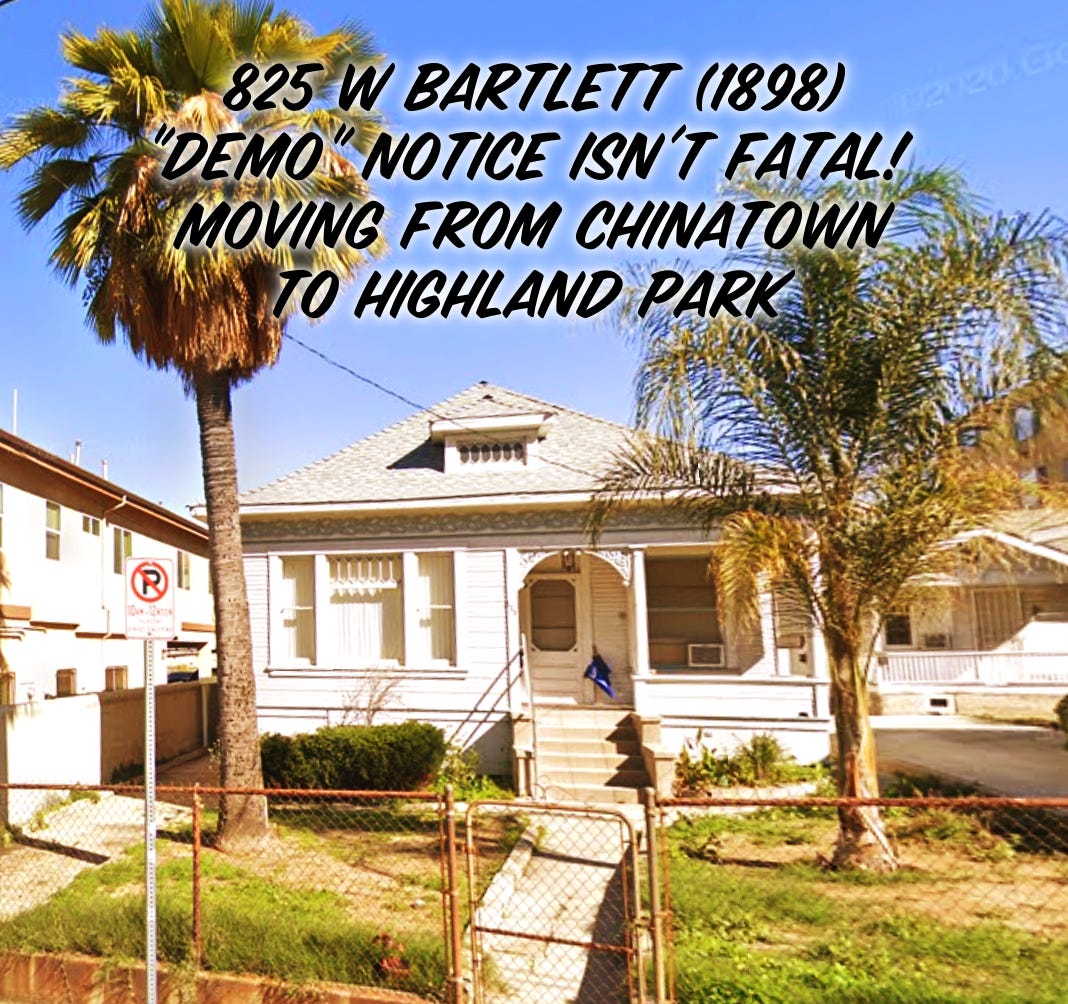
Chinatown Victorian cottage lovers, don’t despair: when you see the demo notice posted at 825 W Bartlett, it’s for deconstruction and moving of the SurveyLA historic resource to 322 N Ave 59. The palms and vintage fence probably won’t be so lucky. (Or maybe not: since we posted about the permit on social media, the application has been withdrawn.)

Born into wealth, Faith Chevallier dedicated her life to aiding prison inmates returning to society and advocating for women on the bench—like Judge Oda Faulconer, who moved into Armstrong after Faith died in ‘35. Today, it’s on Airbnb by the month.

RIP Ye Olde Taco House #1, a quiet Covid casualty that’s been rotting in plain sight across from Angels Flight. Demo sought for no new project. Convenient to The Brass Rail (now La Cita) and the Pershing Square hustling grounds, if that A-frame could talk, you would blush!

The wreckers are coming for 456 N Bristol, the airy English cottage where Pam Lang was stricken months after her agent husband Jennings was maimed for being too attentive to client Joan Bennett. Another gem perfect for Altadena. Somebody, please save it!
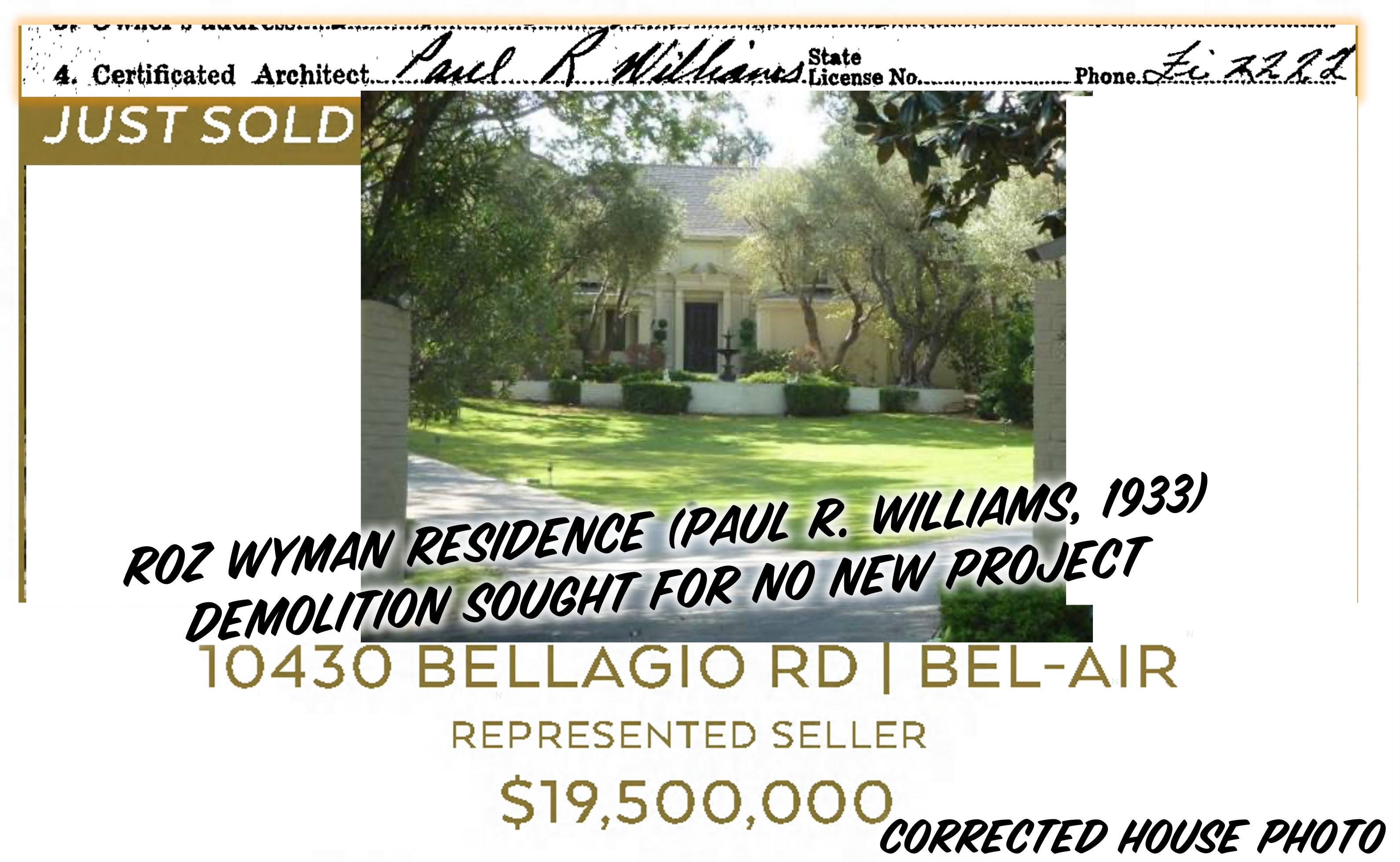
Unlike Marilyn Monroe’s house, City Council punted on landmarking councilwoman Roz Wyman’s Residence, and now her Paul R. Williams designed mansion is slated for demolition. On the right Altadena lot, it could be magnificent again.

We talked with Dave Schilling for L.A. Material about the magnificent LAX Theme Building's exotic restaurant history and decades of demolition by neglect. This might be the poster child of squandered goodwill potential in a city that's made an art of it.


