

Gentle reader,
Wherever you live, odds are your local municipality is sitting on a gold mine of fascinating, unpublished local history. And you’ll probably never get to see it!
Such is the way of government: passionate people pour into public meetings to speak their minds, or labor late into the night on written testimony about stuff they care deeply about—officials meet and confer—they vote (usually to do the exact opposite of what the passionate citizens want)—the vote is documented.
Then the record is quietly filed away, never to be read again.
We want to know everything that’s locked up in a file in Los Angeles, the dustier and deeper the better. We want it all to be digitized, so citizens can know their complicated past, survive the challenging present and shape the future.
And since the City isn’t going to do that voluntarily, we frequently submit public records requests for obscure and intriguing records that we think might exist.

Last summer, as part of a City Planning case file digitization initiative, some unusual items began to hit the planning portal: decades-old rejected Historic Cultural-Monument nominations that had been submitted by citizens and batted down by the appointed Cultural Heritage Board, the more powerful, nimble and activist predecessor of today’s Cultural Heritage Commission.
And one of these rejects purported to be a Los Angeles Volcano at the mouth of Elysian Park. We’ve never submitted a records request faster!
Once we got the file, we went out to see this supposed Volcano for ourselves, as documented in the video at the top of this newsletter.

What we found was something even more intriguing: a still-leaking relic of the city’s early infrastructure that drew Los Angeles River water up to a reservoir to be fed out by gravity along the Zanja Madre ditch system to serve the expanding town.

Also in that slim case file was evidence that being treated like a fly to be swatted away by elected and appointed officials is nothing new.
Volcano nominator Frederick Morrison was born in Northern Ireland in 1912 and emigrated with his family in the early 1920s. The Morrisons lived in a Craftsman cottage at 1020 North Avenue 51, Highland Park. It’s still there.

Frederick’s father, also called Frederick, was a glazier for a sash and door company and his mother Margaret (Madge) clerked in a tobacco and candy shop. All of his siblings grew up and moved away, but Frederick remained into adulthood, living in his parents’ home.
He worked menial jobs, including as a gardener in the County Parks system and in the Southern Pacific Railroad Shops (the footings of this Victorian-era maintenance facility were excavated by archeologists during the grading of the Los Angeles State Historic Park), and developed a passion for discovering local history, architecture and the fading cultural relics of the Arroyo Artist’s Colony.
So he was thrilled to learn that Los Angeles had a Cultural Heritage Board charged with assessing and designating significant sites as Historic-Cultural Monuments, and even moving significant structures that were threatened to the non-profit outdoor museum they’d helped to found, Heritage Square.
Naturally, the board members couldn’t know everything about his neighborhood, and would welcome recommendations from observant citizens.

In September 1973, he sent the Board a hand-written message steeped in oral history and apocalyptic anxiety:
“I think something ought to be marked as a cultural monument, + that is Los Angeles one + only volcano: that is a great sulphur spring, anywhere there is a sulphur spring, there is great volcanic activity down deep underneath the ground.
This tunnel into the spring is a few feet South of the Broadway Entrance of Elysian Park. This is one of the tunnels built by John Holland [sic for William Mulholland] with chain gang labor. The main purpose of building the tunnels was to release the pressure on the hill + keep it from sliding down into the railroad tracks. Every time a truck goes over North Broadway Bridge it trembles its very unsafe because of pressure: the entrance to the tunnel is closed off by an iron gratery, for a long time the bank above the entrance used to be discolored by the sulphur fumes until they piped the water away, you can see the pipes.
There should be a marker there even if it has no cultural influence scientists 2000 years later can dig around the base of the old volcano + say ‘The old inhabitants of LA were well aware of the sleeping giant that destroyed their city.’ This Volcano could be our Paricutín, the volcano in Mexico that broke out in a corn field. Los Angeles could also be covered by a volcano opened up by an earthquake. A great final drama of the disappearance of LA.
All the tunnels including the little one called the Chinees Smugglers Cave were all the work of John Holland [sic] the self taught engineer who conceived the Owens Valley Aqueduct. I was told this by an old switch man called Dewey Hardesty who was often on the chain gang and worked in all the tunnels as his sentence for being drunk and disorderly. There is quite a flow of water from this spring if you can judge by the size of the pipes.
It should be marked for the future discoverers of Los Angeles.
(signed) Yours till the Continent splits, Frederick Morrison”
He didn’t reckon with the Board’s powerful gatekeeper, Ileana Welch.
Welch was already annoyed by Morrison’s peculiar letter and that she had to respond to it. Somehow, she got a glimpse of him—maybe he attended one of the preservation hearings, or dropped by City Hall to talk about his latest obsession. And in directing staff to go out and assess this supposed sulphur-belching, pressure-easing, prisoner-carved Volcano, she actually set down in an official City memo this slur:
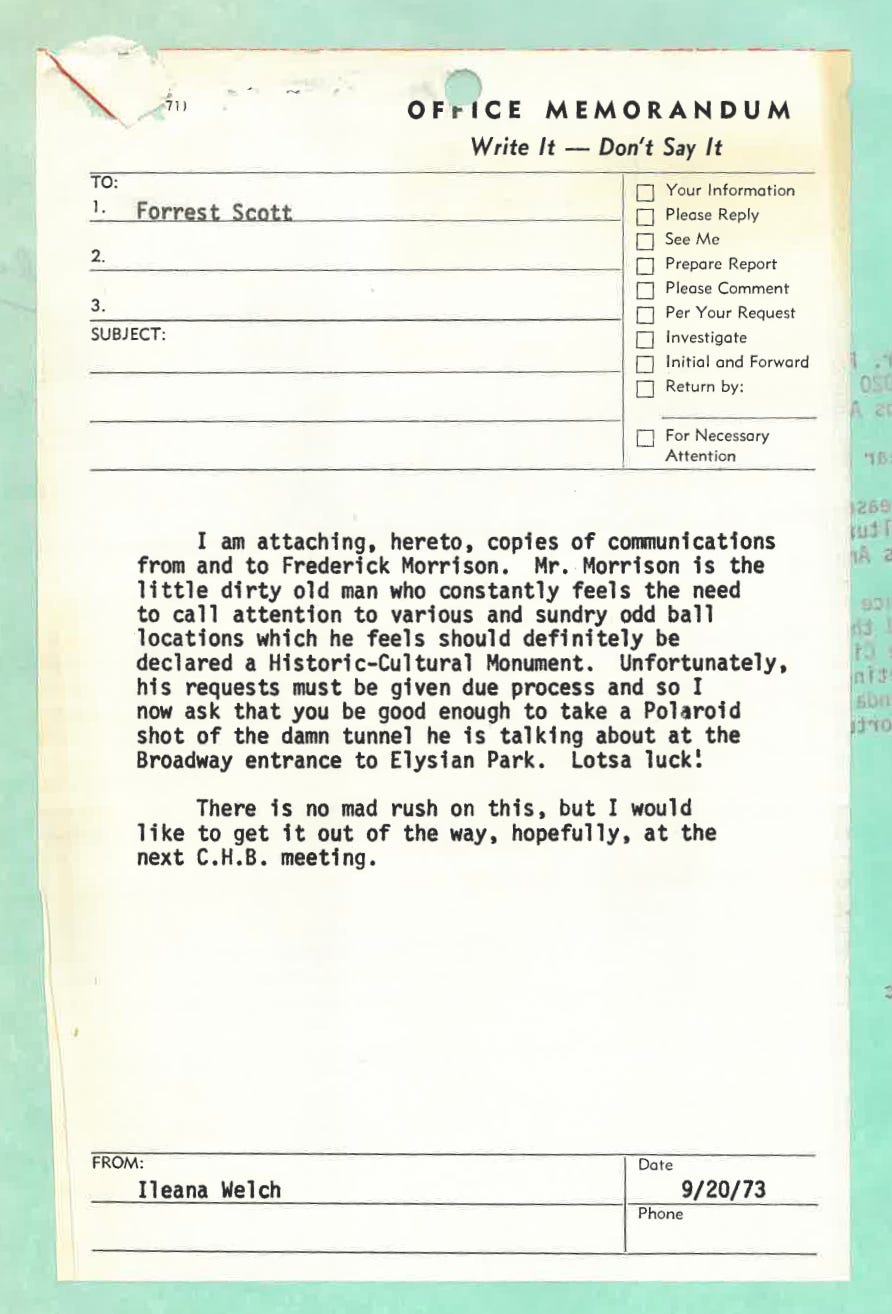
It’s a nasty way to describe a constituent, and as far as the public record shows, not accurate. When he registered for the draft around 1939, Morrison gave his height as 6’1” and his weight as 200 lbs. A strapping fellow in youth, at sixty he was certainly still tall, even if not as husky.
But was he dirty? Well, perhaps he was a bit dusty, as befits a hard-working fellow who spent his life poking around the mouths of obsolete reservoir outlets, picking the brains of alcoholic railroad switch men and peering between the hedges of neglected Arts & Crafts art colonies, looking for landmarks worth saving for future Angelenos to enjoy.
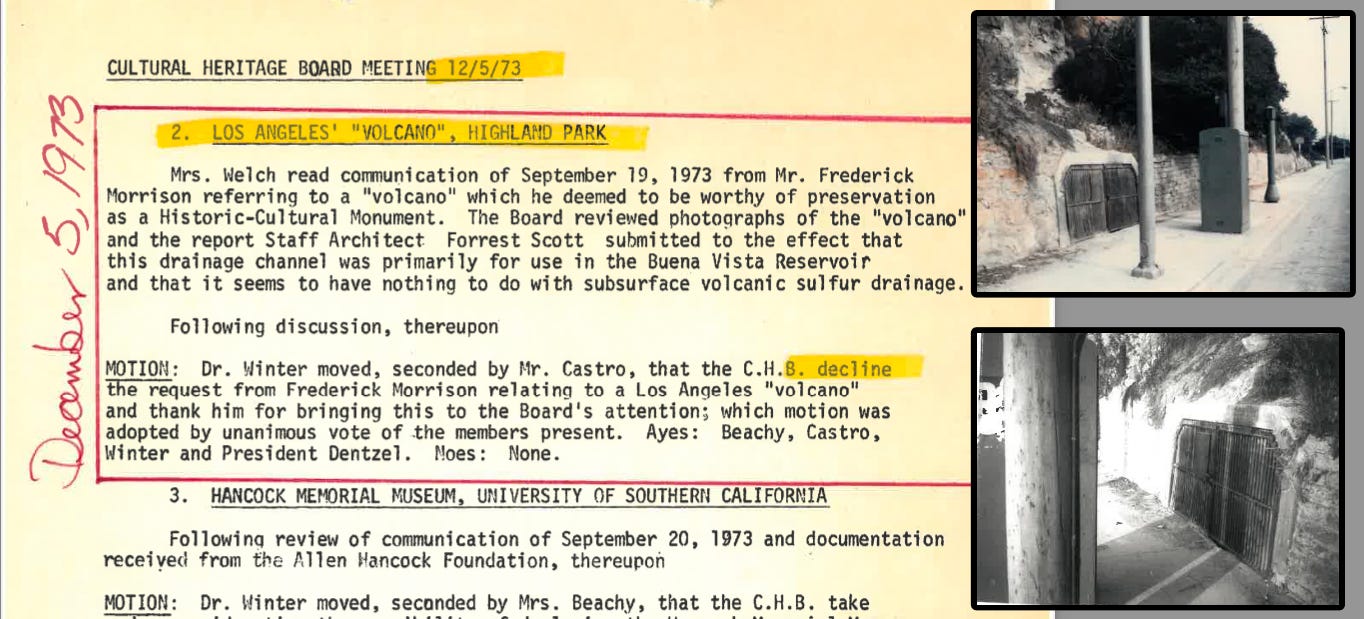
The Volcano nomination was determined to be a dud, rejected after the commissioners reviewed staff findings and Polaroids.
But Morrison had more potential landmarks to pitch, and while some were also rejected, others would find serious fans on the Commission.

• Two palm trees at 5120 Baltimore Street, which Morrison claimed were the oldest in Highland Park, located on the “Rogers Rancho” that had burned down a few years before he arrived in 1923. Nope!

• “Another worthy and usefull house that should be perserved is the house at 5300 Lincoln Ave that is currently up for sale, It is an adobe house and was built in 1904 out of the local black adobe and until 1968 I did not know it was an adobe untill the Mexican who built it told me so. It is so well preserved and taken care off it has stood there withstanding the elements and the earthquakes of 1906, 1924, 1933, 1942, 1961 the whol thing is a good example of what a well built adobe will do and that we should build more residences out of adobe and thus help preserve our forests and not use up so much wood… It is presently occupied by the Acunya family.” Nope!

• “Another house that merits preservation is the one occupied by Lubica Djukich and is located at 6255 Meridian Street right opposite the Garvanza Park and is a exact type of house a working man lived in in 1890. There are no bay windows balconies two stories but it is a house that has no additions only four rooms a back porch on the side and a little porch on the front its paint is peeling off but it looks in pretty good condition.”

Nope! But thanks to Morrison’s suggestion, this sweet cottage was photographed before the Stucco Man arrived with his Satanic trowel.
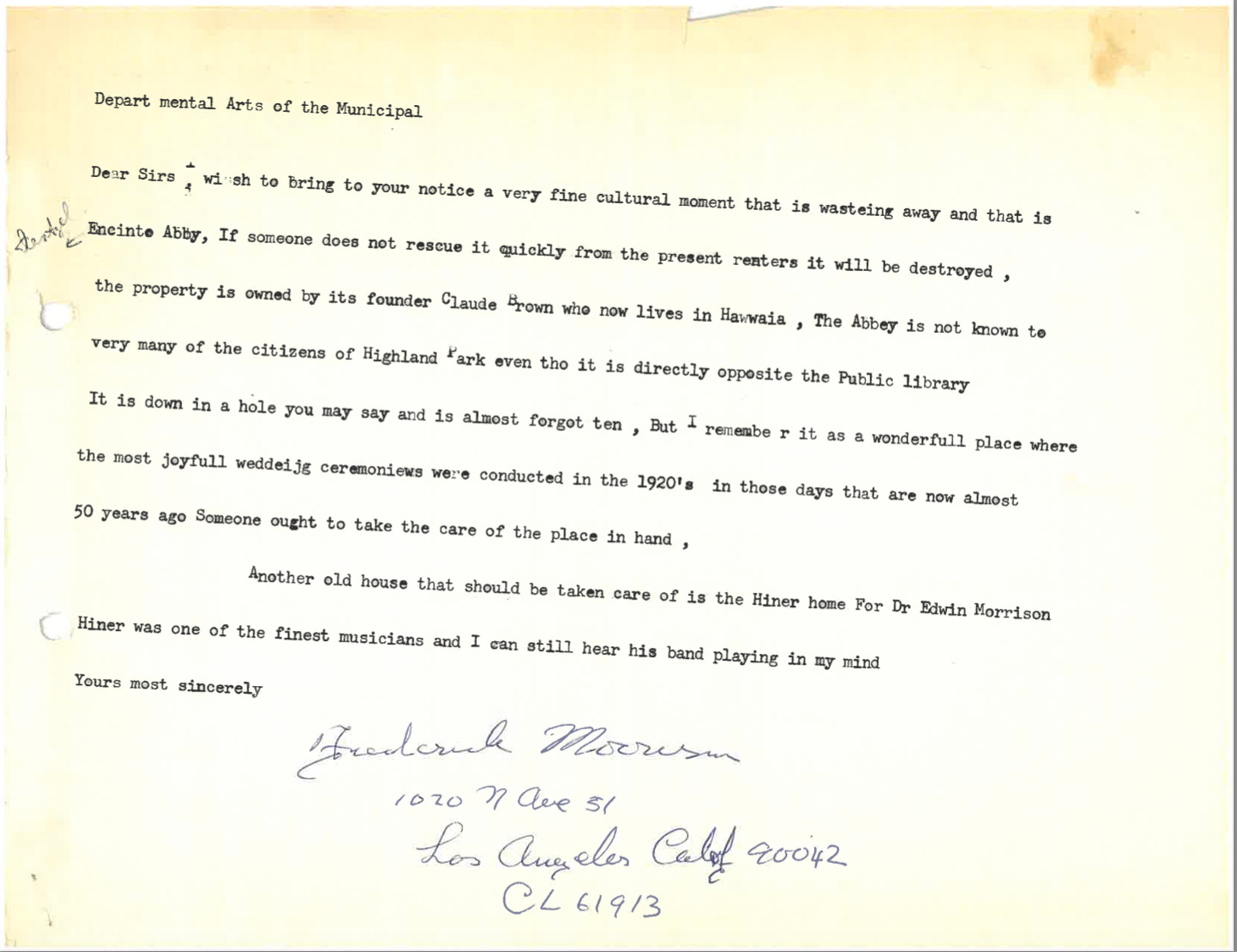
But not every Frederick Morrison landmarking suggestion was batted away. He wrote a letter, urging the Commission to come to Highland Park and visit two of his neighborhood’s gems.
The Board was skeptical—a recent visit to Venice had been a bust (“there wasn’t a thing there worth preserving!”)—but they trekked up the Arroyo anyway. And they were astonished by what they found.

Abbey San Encino, an Arts & Crafts marvel constructed by Jackson Browne’s master printer grandfather Clyde and still in the family, which Morrison warned was in immediate peril from the renters, was quickly declared a City landmark.
If the renters remained, they were presumably warned not to party too hard around the stained glass windows.

Also designated was Edward M. Hiner’s Home, a rocky realm for march music where pal John Philip Sousa lived and rehearsed in his namesake nook and socialized with Mrs. Anna Hiner, dedicatee of “The American Girl.”
Not a bad track record for a “little dirty old man” (not!) who came from Belfast as a wee kid, spent all of his life in Highland Park and fretted that if the Volcano ever blew, future explorers wouldn’t know the marvels and characters who had shaped the city he loved.
He wanted to leave a sign for them, so they’d recognize that they walked in the footsteps of giants.
Here’s to Frederick Morrison, one of those giants, and a preservation pal worth knowing!
Saturday’s walking tour is Hotel Horrors & Main Street Vice, a sweetly sleazy visit to the lost XXX 24-hour fun zone that once lured slumming Angelenos and frisky sailors on shore leave to lose their inhibitions and get an experience they wouldn’t soon forget. From all-nite theaters to freak shows and tattoo parlors, cheap hotels and legendary burlesque halls, the stories are too good not to share. Join us, do!
Now scroll down for Closely Watched Trains, links and news you can use.
Yours for Los Angeles,
Kim & Richard
Esotouric
Are you on social media? We’re on Instagram, Twitter, Facebook, YouTube, Mastodon, Threads, Bluesky, Substack Notes, TikTok, Nextdoor and Reddit sharing preservation news as it happens. New: some of these newsletters are on Medium, too.
Our work—leading tours and historic preservation and cultural landmark advocacy—is about building a bridge between Los Angeles’ past and its future, and not allowing the corrupt, greedy, inept and misguided players who hold present power to destroy the city’s soul and body. If you’d like to support our efforts to be the voice of places worth preserving, we have a tip jar, vintage Los Angeles webinars available to stream, in-person tours and a souvenir shop you can browse in. We’ve also got recommended reading bookshelves on Amazon and the Bookshop indie bookstore site. And did you know we offer private versions of our walking tours for groups big or small? Or just share this link with other people who care.
UPCOMING WALKING TOURS
• Hotel Horrors & Main Street Vice (7/11) • Hollywood Noir (7/18) • Evergreen Cemetery, 1877 (7/25) • Raymond Chandler’s Noir Downtown L.A. (8/1) • Film Noir / Real Noir (8/8) • Angelino Heights & Carroll Avenue (8/29) • Franklin Village Old Hollywood (9/12) • Westlake Park Time Travel Trip (9/26) • Bunker Noir! True Crime on Los Angeles’ Bunker Hill with Nathan Marsak (10/3) • Charles Bukowski’s Westlake (10/10) • Film Noir / Real Noir (10/24) • Hallowe’en at Evergreen Cemetery, 1877 (10/31) • The Real Black Dahlia (11/7) • Richard’s Birthday Weird West Adams Tour & Elmer McCurdy Museum Visit (11/14) • Angelino Heights & Carroll Avenue (11/21) • Hollywood Noir (11/28)
CLOSELY WATCHED TRAINS

A surprise Walker’s Cafe motion from Tim McOsker, who knows this San Pedro landmark matters, sets aside the Harbor Area Planning Commission’s rejection of the appeal of the oversized back house. Could this iconic Chinatown location get a fair shot at reopening after all?
Late in Kevin de Leon’s scandal-hobbled City Hall term, his office hallucinated Los Angeles history like a drunken chatbot. When he sought to honor a mythical gay donut shop rebellion on Main Street, we brainstormed independently to turn the program into an apology by the LAPD to Nancy Valverde, a Lesbian activist who was repeatedly arrested for dressing in male clothing in the 1950s.
One of de Leon’s motions, to change the name of Pershing Square, quietly died with no action on June 26. We’d been tracking the council file and shared on social media that it had expired.
But then, after doing nothing to advance it since taking office in December 2024, councilmember Ysabel Jurado revived the zombie motion!

The problem? Both de Leon and Jurado propose to rename Pershing Square “Biddy Mason Park,” as a form of belated recognition for a remarkable woman who came to Los Angeles on foot as a slave, fought for her freedom and built a fortune as a healer, philanthropist and real estate developer.
Biddy Mason certainly deserves prominent civic honors. And she has had those honors, since 1989, when BIDDY MASON PARK was unveiled, three blocks away from Pershing Square, on the site of her original homestead!
Here’s what historian Nathan Marsak wrote when the motion was first introduced.
Read the public comments from Summer 2024 for reasons why local historians question the motion, including a thoughtful suggestion from legal scholar Bob Wolfe that Pershing Square should be renamed to honor our first Latino mayor Cristóbal Aguilar, as the one who dedicated the land for park use in 1866.
Because like de Leon before her, Jurado has not engaged in a public dialogue with historians and community members about her proposed civic renaming campaign, it’s difficult for the public to understand the reasoning behind the proposal—both the move to remove General John J. Pershing’s name, and to honor Biddy Mason in his place.
We believe proposals to rename significant civic places deserve to be hashed out in open dialogue with the community of concerned citizens, historians and other stakeholders before they reach the motion stage. The public has a right to weigh the historical evidence and express their opinions before public resources are used in this way.
Our sincere hope is that if elected officials want to honor significant people in historic spaces, they reach out to local historians and ask for suggestions, which will be freely given with a smile. This tactic of uninformed people in positions of power proposing inaccurate and unnecessary civic recognition seems to us a waste of time and City resources and it drives people who actually care about Los Angeles history nuts. JUST STOP IT!
We’ll keep watching Jurado’s revived motion and let you know if any public hearings are scheduled. In the mean time, concerned citizens are welcome to submit written public comments by clicking the red pencil button that says NEW.

In 1996, Jonathan Gold found just three perfect L.A. taquitos worth reviewing: Ciro’s Boyle Heights (where we named Esotouric!), Pepe’s No. 2 Downey and Cielito Lindo Olvera Street. Only the just reopened Cielito Lindo survives and Angelenos need to show up hungry and keep the grease pots sizzling!

Coming soon from Herb Lester and Esotouric: a new edition of How to Find Old Los Angeles, which was a map, grew into a book—out of print, we have a few copies left—and is a map again. It pained us to delete some beloved, shuttered favorites, but this city is still lousy with old school gems we want you to love, too. The map will available on tours and by mail soon, but if you can’t wait, you can order direct from Herb Lester.

Dozens of large 1920s multi-family RSO buildings are hitting the market in a wave. Will Los Angeles leaders act to keep modest, stable housing like The Fedora Arms Apartments populated? We fell in love with this facade visiting Papa Cristo’s (RIP).

The charming, perpetually vacant storefront at Pico and Stanley put those big plate glass windows to good use in 1949, when Television Boys showed off the latest in Hallicrafter console boxes. They’ll even lug one over to your place for a home demo. Out of town? Call collect!

Behold, the most beautiful entry on Crown Hill! The magnificent griffin and dolphin frieze symbolizes the power of the press, which is fitting, as the 1924 Stange Apartments, architect unknown, figures in the recall of dirty judges for a real estate scam.
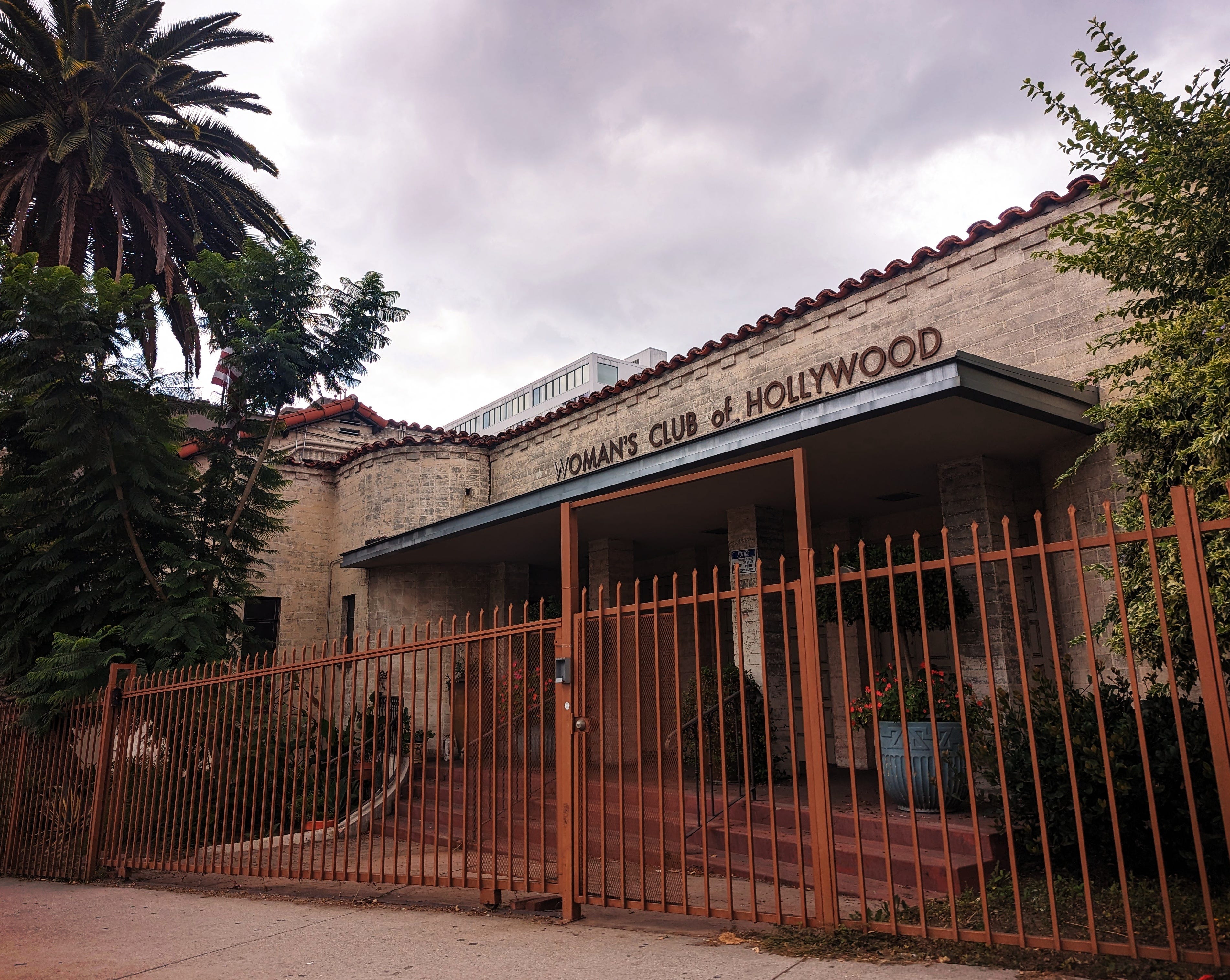
A red alert from the Woman’s Club of Hollywood (est. 1905): after decades of internecine squabbles and last minute saves, its landmarked clubhouse at 1749 N. La Brea is up for foreclosure auction on August 30. They’re looking for an angel to keep it safe.

LACMA’s marketing team desperately wants to make the value-engineered Zumthor debacle into a star, but leave it to legendary architectural photographer Tim Street-Porter to call it straight: the Emperor is stark naked and “depressingly unattractive.” Our public records search that showed Angelenos overwhelmingly opposed this costly demolition.
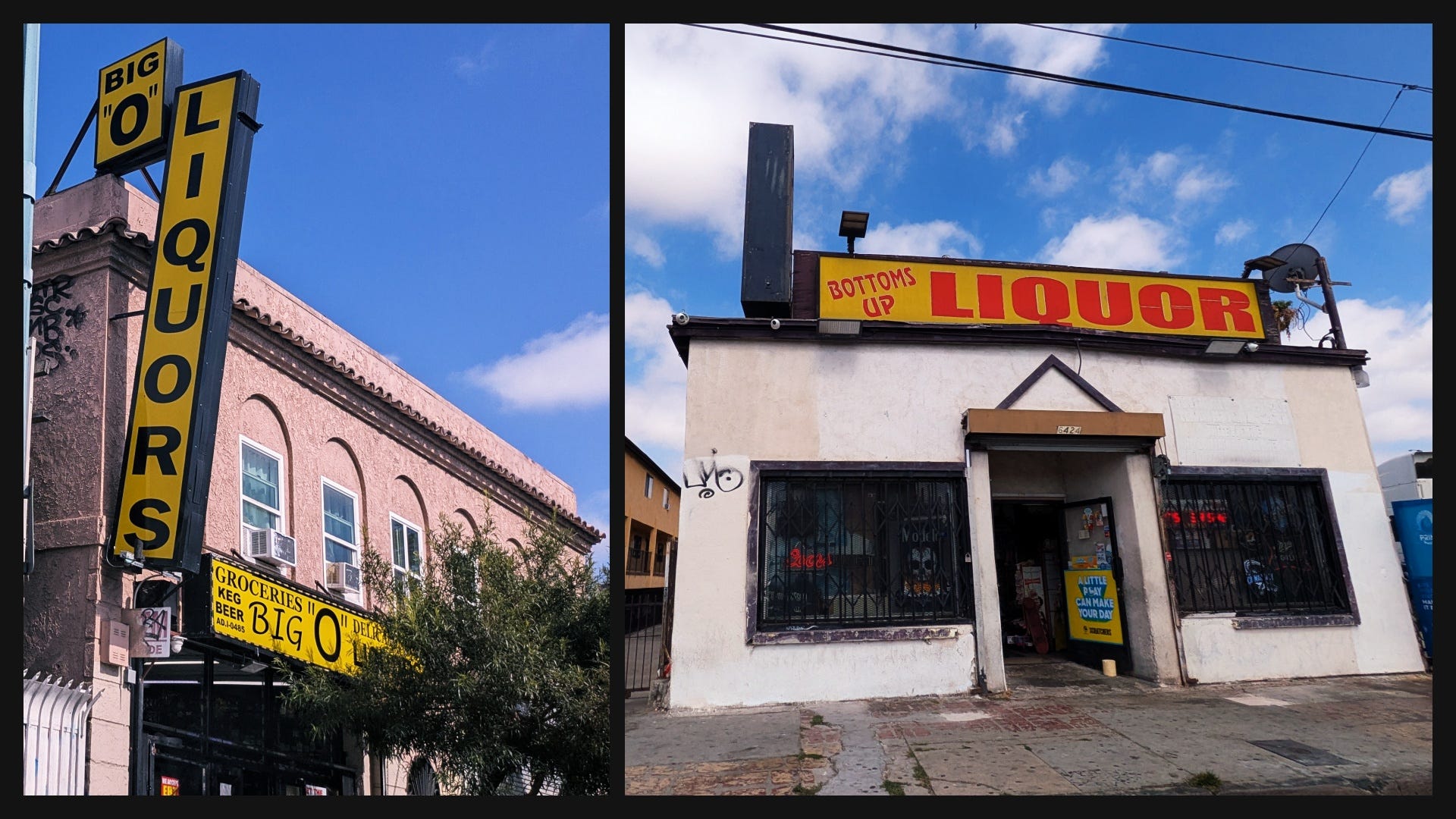
We’re sensing an erotic/alcoholic theme on Vermont Avenue in South Los Angeles. Salud!
Farewell to Burrito King No. 1, the favorite late night stop of Echo Park rock ‘n rollers and all day regulars since 1968. Seeing the vacant stall, right after the cleared Taix lot, was non bueno. Y Que Trading Post on Vermont has permission to save the sign, so pirates, stay away from the l’il burro!

Three pretty turn-of-the-century cottages, boarded up with demolition notifications posted—even though no required email was sent to Councilman Curren Price—surrounded by dead grass. And this 4th of July, firefighters saved one and all. Thanks, LAFD!

Preservation’s greatest friend in City Hall was Billy G. Mills, a true leader willing to fight the establishment to serve his constituents and protect the neglected city-owned Engine House No. 18 (John Parkinson, 1904) from demolition to be an arts center. We’ll visit this landmark and honor its champion on the Weird West Adams tour on November 14.
Things got spicy on the LosAngelesPreserved subreddit this week. Come over and chat about places that matter. YIMBY: “Corruption is good, actually.” LACMA staffer: “Peter Zumthor’s toilets really stink!”

A modest proposal from the 7800 block of South Broadway: density doesn’t have to consist only of boring boxes. Southern California has so many cool architectural styles that could be incorporated into new projects, if developers or the City cared. Angelenos deserve beauty. Even the pro-development crowd agrees!
A short Library Commission agenda with a mighty big scoop: LAPL seeks to purchase a perpetual license for the digital version of the Herald-Examiner newspaper (1873-1989). It’s available through Genealogy Bank, but LAPL is free!

Wild cameo in this story about Mt. Washington residents dismayed by abandoned developments: Jose Huizar prosecutor Mack Jenkins, as frustrated with CD1 as everyone else! Meanwhile, a lawsuit on the far side of the hill exposes corrupt hillside permits.

Sacramento density (SB 684) meets the passionate preservationists of L.A.’s first HPOZ. Save Angelino Heights cites fire risk of aging hydrants with low water flow: “City must prioritize human lives and infrastructure over rushed developer deregulation.”

Meet Vilma: her red-hot Clifton’s Cafeteria camera girl diary is an only-in-Los-Angeles tale you want to hear straight from her beautiful daughters. Tune in for free on Zoom 7/15 with Society for Commercial Archeology and catch Vilma fever!

Mike Callahan compared the maps, and believes Los Angeles City Planning is using outdated Very High Fire Hazard zone information. We’re concerned that this error could encourage speculators to buy and empty out residential buildings ineligible for SB-79 low rise development.

City Planning has exhibited an alarming pattern of carelessness that encourages demolition of existing housing. Even when the City maps say a Very High Fire Hazard Severity Zone exists, with accompanying restrictions for public safety, every permit must be scrutinized. A huge project was wrongly approved at Franklin and Whitley and a citizen appeal rejected. It’s now an entitled vacant lot on the market as a Development Opportunity in Prime Hollywood.

The yellow and brick and cowardly lions made these L. Frank Baum lovers fall hard for the McGonigle Apartments (Arthur L. Acker & Hudson and Munsell, 1924) at Vernon and Vermont.
A surprising item on the Cultural Heritage Commission agenda for 7/16: proposal to install digital signs on the roof of The Original Pantry Café. Seems unlikely, since Richard Riordan sold off the air rights to preserve the landmark.
Also on the 7/16 agenda: Commission review and comment on proposed perimeter fencing of the landmarked MacArthur Park. We’re very concerned about access, aesthetics, harm to heritage trees and the very high cost. The public can attend and address the Commission, or make their public comments virtually or in writing.


