

Gentle reader,
This story begins with a seemingly ordinary Cultural Heritage Commission hearing about fencing MacArthur Park, and ends with the unexpected departure of one of the city’s most experienced preservation commissioners.
And it leaves us asking: how can Los Angeles function if the expert commission charged with protecting its historic places cannot speak freely or act with authority?
Read on for all the details and a modest proposal we believe could do a great deal to strengthen this troubled city. If you agree, we hope you'll share it with your City Councilmember.
On July 16, we went to City Hall to attend a Cultural Heritage Commission hearing including presentations that would have an outsized impact on protected landmarks.
First was Mayor Karen Bass' and Councilmember Eunisses Hernandez's proposal, presented by the Department of Recreation and Parks, to enclose MacArthur Park behind an eight-foot-tall, multi-million-dollar iron fence.
And later came developer Leo Pustilnikov's proposal to install enormous digital billboards atop the shuttered Original Pantry Café.

Because the Cultural Heritage Commission serves in an advisory role whenever owners or government agencies seek to alter designated landmarks, commissioners reviewed presentations, heard public comment and discussed both proposals. Neither item required a vote. Instead, commissioners could offer guidance and ask applicants to return with revised concepts.
We expected an interesting hearing, so we filmed it.
Although CHC meetings routinely revolve around photographs, renderings and architectural drawings, the City archives only the audio of Zoom hearings. It's a deeply flawed way of preserving the public record.
In light of subsequent events, we’re especially grateful we can share the whole MacArthur Park hearing with you.
The discussion quickly grew beyond details on a proposed new fence.
Citizens spoke passionately about public safety, law enforcement, organized crime, addiction, sanitation, tree preservation, the historic landscape and decades of civic neglect.

Among the speakers was longtime City Hall gadfly Wayne Spindler, who set aside his profane "Goat Puppet" persona to offer something unexpected.
Speaking not as a provocateur, but as a solo practitioner immigration attorney who regularly travels through Westlake late at night, Spindler described witnessing the City's failure to control the gang-dominated drug trade and the devastating human consequences surrounding MacArthur Park.
His remarks echo those of Norm Langer, who has refused to abandon the delicatessen his family founded, despite overwhelming civic dysfunction.
Spindler, who has been in a hot war with local government for years, came to City Hall to share his perspective on MacArthur Park with the only official body that would listen respectfully while he addressed them respectfully. And in our opinion, his comments had a direct and profound impact on the commission’s deliberations.

Only one speaker who participated in the actual hearing supported the fence. She later called for Commission President Barry Milofsky to be removed, apparently believing he was a City employee. (Scroll to the end of our video for a second pro-fence speaker, former CD1 City Council candidate and FPPC ethics complaint filer Raul Claros, who arrived too late for the public comment period and spoke after the item was closed.)
As discussion continued, the commissioners considered aesthetics, public safety, tree health, project cost, the lack of broader planning by Recreation and Parks and whether an expensive fence would meaningfully address the underlying problems afflicting the park.
By the end of the discussion, the Commission was clear on one thing: they didn’t like the fence.
Then Commissioner Richard Barron, drawing on twenty-two years of service, proposed doing something more than simply offering comments.
“Can we send a letter to Parks and Rec from the Commission stating our position on this fence? ... I think we need to go higher above their pay grade to the people who are making the decisions... I think we need to go on record as this Commission is very much opposed to this idea.”
Barron wasn’t simply offering his personal opinion. He was asking the Commission to formally oppose a proposal it believed would harm one of Los Angeles’ most significant historic landscapes.
As far as we know, that request became Richard Barron’s final official act as a Cultural Heritage Commissioner.
We expected to write about the hearing after the Commission’s letter was drafted. Instead, two weeks later, the story shifted.
On July 30, Mayor Karen Bass transmitted a report to City Council announcing the appointment of Victor Jones to the Cultural Heritage Commission.
The accompanying report states only that Jones will fill "the vacancy created by the departure of Richard Barron."
There was zero sign at the July 16 hearing that Richard Barron planned to step down, or knew his 22-year term of service would not be extended. His name is on the agenda for the August 6 (cancelled) meeting and he was looking forward to being involved in further park discussions in the weeks to come.
In our informed opinion, Barron was doing exactly what he had been appointed to do: offering independent judgment in service of Los Angeles and its historic places.
His departure saddens us.
Its timing troubles us.
Because Barron’s removal also fits an unsettling recent pattern.

In less than a year, two other long-serving, highly competent commissioners left the Commission shortly after advocating for threatened historic places.
Last March, Commissioner Diane Kanner (appointed 2017) drew her colleagues’ attention to the City’s bizarre and byzantine treatment of Boney Island, the beloved San Fernando Valley treehouse and folk art environment created by Simpsons’ producer Rick Polizzi.
She referenced a Los Angeles Times feature story about the City’s efforts to force Polizzi into criminal court over LADBS demands that were, by his account, impossible to satisfy, and his announcement that he intended to demolish the treehouse rather than continue fighting.
Kanner asked an obvious question: Could the Cultural Heritage Commission call a special meeting to consider landmark status for the popular attraction?
The answer she received from the staff member assigned to respond was no—not because Boney Island was unworthy, but because the CHC could only act at its regular twice-monthly meetings.

But the Commission’s own rules provide a mechanism for emergency consideration, and there was just enough time to act. Alas.
Within days, the great and unusual Boney Island was gone, and we were there to catch its bloody sap in a paper cup. And a few months later, with no fanfare, Diane Kanner was no longer on the Cultural Heritage Commission.
Then came the Hollywood Center Motel.
After the property’s new owner was blocked from obtaining demolition permits because no replacement project had been proposed, the 1904 house, 1920s bungalow court, 1950s neon sign and distinctive breeze block wall were all vulnerable.
A landmark nomination from Hollywood Heritage came before the CHC in December.
The hearing became less a discussion of architecture than an urgent appeal for help. Speaker after speaker warned the Commission that the property was being destroyed through neglect.
Brian Curran (Applicant/Preparer, Hollywood Heritage) explained: "This is a threatened historic resource... The property was soon ransacked and heavily vandalized. Two fires occurred in the past few months..."
John English warned that unless the site was secured immediately, "there will be no resource left to designate."
Jessica Sanchez, a volunteer with the Hollywood Heritage Museum and a case manager working with low-income individuals and unhoused Angelenos, pointed out the painful contradiction: “If there were people living in it, then other people wouldn’t be able to vandalize it. And so I think it’s a shame for structures that still exist to be demolished when there’s people outside of them that could be living in them.”
Esther Daack observed “I need to reiterate the urgency. In a very short period there will be nothing left to save.”
We shared our own observations from repeated visits to the site: "This property has burned twice... The second one nearly took out an inhabited building next door. Everyone's breathing it. It's highly dangerous. And they could put metal gates on these buildings if they wanted to. It's expensive, but they can be secured. They're choosing not to."
Commissioner Gail Kennard (appointed 2010), listened and agreed: “The best outcome, I would think, would be to use this site to provide housing for those who need it... I think we owe it to ourselves to go out and consider the property... I hope that we can do all we can on the City Family side, on the private owner side, to protect this resource for whatever its future holds.”
Everyone in the room understood this was an emergency. The tragedy was that nothing could be done about it.
The Cultural Heritage Commission could recommend. It could encourage. It could ask. But it could not compel the property owner to secure the buildings. It could not order the City to intervene. It had no magic wand.
This lack of authority has become a recipe for lost landmarks.
A month later, before the commissioners could even tour the property, the main house burned in a pre-dawn fire that remains under arson investigation.
Within hours, the standing structure was demolished by LAFD, without permits and without consultation with either the Cultural Heritage Commission or Hollywood Heritage.
Three days later, Mayor Karen Bass nominated Dr. Laura Dominguez, a postdoctoral scholar at USC’s Huntington Early Modern Studies Institute, to replace Gail Kennard.
Diane Kanner championed the preservation of Boney Island, only for City staff to undermine her ability to act.
Gail Kennard expressed alarm about the Hollywood Center Motel, but had no tools to compel the City or the owner to protect it from the inevitable consequences of neglect.
Richard Barron led the challenge to the proposed MacArthur Park fence, and like Kanner and Kennard before him, is now gone.
Whether intended or not, this pattern creates a chilling effect.
A preservation commission cannot function if its members fear that frankness may shorten their public service.
And citizens cannot fully trust a public body to act in the best interest of heritage if they suspect that real advocacy will be punished.

When Cultural Heritage was a Board, the members could accomplish extraordinary things, like forming a nonprofit to fundraise and move demolition-threatened buildings to Heritage Square. We desperately need that kind of creativity backed by civic power to help rebuild Pacific Palisades and Altadena.
Today, the CHC is limited to making recommendations and hoping other parts of the City Family, private owners and elected officials choose to listen.
That is not enough.
Sixty percent of the Commission has been replaced in less than a year!
With those departures, Los Angeles loses nearly five decades of combined institutional knowledge.
That should concern every Angeleno who values honest civic process.
Because this isn’t just a preservation issue. It is simply the lens through which we have observed a larger problem: a sick government that rejects expert advice from citizens, professionals, commissions, neighborhood groups, insisting instead on doing everything itself—badly.
Every commission depends on qualified volunteers willing to do the work honestly. If commissioners fear that doing this will have political consequences, nothing they do matters.
We respectfully object to this pattern of erasure, intimidation and silencing.
Los Angeles needs a Cultural Heritage Commission with the authority to act fast, before an historic resource becomes a neighborhood’s problem.
Today, neighbors often spend months watching historic buildings deteriorate. They file complaints, they call the cops, they pester their councilmember, they ask for help. But nobody helps.
But by the time the City responds, the building is too far gone, and frequently surrounding buildings go down with it.
We believe the Cultural Heritage Commission should be empowered to intervene earlier in the process—to address vacant, unsecured and blighted historic places before they become emergencies requiring LADBS enforcement, police response or emergency demolition.
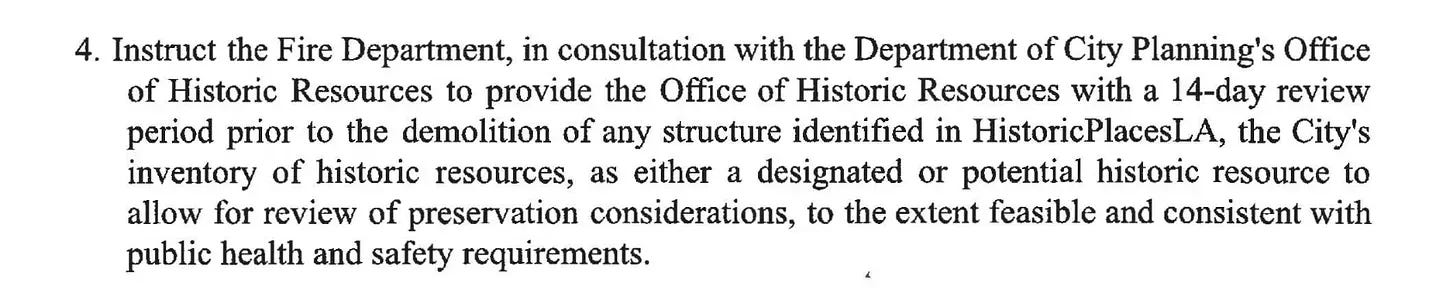
This week, after a last-minute letter from the Los Angeles Conservancy, an alarming motion about granting the Fire Department expanded power to quickly demolish problem buildings was amended to include a brief period of oversight by the Cultural Heritage Commission.
This was exactly the right choice.
But it is only a beginning.
The CHC shouldn’t be the surgeon called to treat a patient who is nearly dead. It should instead be the specialist who looks at an ailing building in a troubled neighborhood and moves nimbly to bring both back to health.
The way to do that is to grant the CHC more power, and encourage citizens who are already reporting vacant, unsecured, vandalized historic properties to different City agencies to bring their complaints to a body that actually cares about saving old buildings.
These relatively small changes to the Municipal Code would give citizens who feel increasingly ignored a place in City Hall where they can make progress.
Through caring for our shared heritage—something most Angelenos treasure—we believe Los Angeles can begin to right itself and regain its lost respect.
Richard Barron stood up for the independence of the Cultural Heritage Commission and went out roaring.
Now Angelenos need to show up for the Commission he served so well.
So please email your City Councilmember today and tell them:
“I am asking you to work with preservation groups to initiate legislation giving the Cultural Heritage Commission more authority to act when landmarks and potential landmarks are vacant, unsecured and blighted, and to continue meeting with preservation groups to find new ways of protecting our shared heritage from demolition by neglect and neighborhoods from the toxic impacts of burning asbestos and lead paint.”
It’s a small thing that could have a big impact, so let’s make it happen!
Now scroll down for our straight-from-the-courthouse report on this morning’s wild motion to dismiss hearing in the ongoing public corruption case against councilmember Curren Price, upcoming tours, a last chance to support our preservation and journalism with a half-price paid subscription and Closely Watched Trains you won’t want to miss.

If you appreciate what we do to keep you informed and look out for Los Angeles, you can still take advantage of the half off subscriber tier through tonight. This newsletter will always be free, but every paid subscriber directly contributes to making this work possible.

This Saturday’s walk is Film Noir / Real Noir, with special guests Bunker Hill native son Gordon Pattison and neighborhood historian Nathan Marsak. The tour honors Film Noir’s abiding influence through visits to select filming locations and the lost landscape of Victorian Bunker Hill, where real life noir narratives were captured by dogged crime reporters, bringing inspiration to Hollywood screenwriters in their daily newspaper.
Join us, do!
Yours for Los Angeles,
Kim & Richard
Esotouric
Are you on social media? We’re on Instagram, Twitter, Facebook, YouTube, Mastodon, Threads, Bluesky, Substack Notes, TikTok, Nextdoor and Reddit sharing preservation news as it happens.
Our work—leading tours and historic preservation and cultural landmark advocacy—is about building a bridge between Los Angeles’ past and its future, and not allowing the corrupt, greedy, inept and misguided players who hold present power to destroy the city’s soul and body. If you’d like to support our efforts to be the voice of places worth preserving, we have a tip jar, vintage Los Angeles webinars available to stream, in-person tours and a souvenir shop you can browse in. We’ve also got recommended reading bookshelves on Amazon and the Bookshop indie bookstore site. And did you know we offer private versions of our walking tours for groups big or small? Or just share this link with other people who care.
UPCOMING WALKING TOURS
• Film Noir / Real Noir (8/8) • Angelino Heights & Carroll Avenue (8/29) • Franklin Village Old Hollywood (9/12) • Know Your Downtown Los Angeles (9/19) • Westlake Park Time Travel Trip (9/26) • Bunker Noir! True Crime on Los Angeles’ Bunker Hill with Nathan Marsak (10/3) • Charles Bukowski’s Westlake (10/10) • Film Noir / Real Noir (10/24) • Hallowe’en at Evergreen Cemetery, 1877 (10/31) • The Real Black Dahlia (11/7) • Richard’s Birthday Weird West Adams Tour & Elmer McCurdy Museum Visit (11/14) • Angelino Heights & Carroll Avenue (11/21) • Hollywood Noir (11/28)
CLOSELY WATCHED TRAINS

First train into the station is this morning’s 995 motion to dismiss hearing for Councilmember Curren Price, held on the high-security Department 106 floor of the downtown Foltz courthouse before Judge Larry Paul Fidler.
The small courtroom was packed to standing room with Price’s supporters, the usual heartbreakingly slim number of journalists, and a few pals from the historic preservation and civic reform worlds. (See our previous reporting on this case.)
Price was accompanied into court by his regular counsel, Michael Schafler, but it was associate Alyssa Bell who did the talking today. Schafler and Bell were part of convicted County Supervisor Mark Ridley-Thomas’ 2023 appeal team. More on him and that appeal below.
Bell argued that Judge Shelly Torrealba had erred when she ruled, after a week-long preliminary hearing, that there was sufficient evidence for Price to stand trial on charges of embezzlement, conflict of interest and perjury.
The DA’s whole case, Bell argued, fell apart because there was no direct evidence that the councilmember knew he had conflicts of interest when he voted on development and municipal projects in which his wife had a financial interest. There were no texts or emails from the councilmember scheming to hide information, and in this digital age, that stood out.
Several times, Bell asked if the judge had any questions. He did not.
She challenged the statute of limitations for some charges and objected to the DA having just added the conspiracy-related Bruder case to the complaint, arguing that it should be waived. Judge Fidler, who had been listening intently, reared up.
Not waived in front of me!”
Bell respectfully disagreed, and Fidler disagreed right back.
Should the matter continue to trial, we predict there will be fireworks over Bruder.
Deputy District Attorney Casey Higgins, for the People, spoke softly and firmly. A 995 was simply about whether there was enough evidence to go to trial. The evidence presented at the preliminary hearing was enough to unwind the contracts made via City votes where Price should have recused, and for the Rules, Elections, and Intergovernmental Relations Committee of Los Angeles City Council to remove Curren Price from office!
But, he observed wryly, City Council had chosen not even to meet today!
Speaking slowly for the court reporter, he spelled out some of the projects and developers whose contracts could potentially be voided under State ethics law: Jordan Downs, Depot at Hyde Park, Metro, Thomas Safran.
It was some list: hundreds of millions of dollars in grants and private investment built upon questionable votes, now potentially vulnerable to legal challenges, though what such action might look like is unknown.

Higgins didn’t spell out Harridge Development Group or its Crossroads Project, but we immediately thought of the Selma-Las Palmas courtyard apartments, a block of rent-stabilized, pre-war units emptied out by Price’s wife, Del Richardson, only possible because Price voted against declaring it a landmark.
The blight half a block south, at Hollywood Center Motel, flowed directly out of this corrupt displacement and hyper-valuation of the dirt under the historic landmarks.
If what Higgins says is true, then the vote to deny landmark status for these 84 rent-stabilized units may be vulnerable, and it is only a matter of Hollywood City Councilmember Hugo Soto-Martinez having the guts to write a motion calling for this affordable housing in his district—which was wrongly removed from the market—to be returned to its proper use, via a new landmark hearing, reversal of the improper evictions or cash-for-keys payouts, and voiding of development plans that rely on the apartments being demolished.
If Soto-Martinez won’t do this—and you can tell him you think he should—any citizen can try.
Section 1090 provides that contracts made unlawfully, by elected officials who had a personal financial interest in the outcome, can be voided.
And it’s not just Curren Price whose votes transformed Los Angeles in ways that may be illegal and could potentially be reversed. Confessed racketeer Jose Huizar presided over hundreds, if not thousands, of votes as chair of the PLUM Committee, a powerful position that determined which projects advanced through the City’s development maze.
City Council has made no effort to identify questionable Huizar votes, including the one that rewrote our own Los Angeles Times building landmark nomination. And Mayor Karen Bass has paid millions to provide rooms for homeless people in the LA Grand Hotel, owned by Huizar’s fugitive co-conspirator Wei Huang.
Higgins expressed incredulity that Price—no matter how well his staff and his wife’s staff obscured the names of LLCs on a thumb drive passed hand-to-hand so its contents could never be called up in a public records search—was ignorant of the high-profile contracts that Del Richardson & Associates began to ink after Price was elected to City Council.
Of course he knew!
We turned around to look at Del Richardson, who was dressed all in white in the row just behind us. She had a lacy white hanky pressed against her face, obscuring everything but her eyebrows.
We would turn to look several times over the remainder of the hearing, and never saw Del’s face.
Higgins continued: Price set up a wall of ignorance, so that if the day ever came that he was called to answer, he could claim not to have known. That ignorance extended to his staff—one of them only found out what his wife did for a living from the Los Angeles Times.
Both the defense and prosecution sought to use People v. Chacon (2007), a case involving a member of the Bell Gardens City Council who attempted to blame her own unethical acts on bad advice received from others in City Hall.
Price’s defense is that his staff screwed up. The People counter that the buck stops on his desk, and it doesn’t matter if he didn’t read the Form 700 Statements of Financial Interest he signed under penalty of perjury.
Price, tucked behind two defense attorneys, leaned forward, dragging his fingers down from cheek to chin.
Higgins observed that when the City’s benefits office learned that Del Richardson had wrongly received $33,800 in medical coverage when she was falsely represented as Price’s legal spouse, the City Attorney directed that no investigation be made and no repayment sought.
That shows how much power Curren Price had.
The hearing concluded with Alyssa Bell’s rebuttal.
Everything alleged was just an honest mistake by employees doing their best to filter the hundreds of conflicts against thousands of votes. (It’s not well known, but under California ethics law, such a scale of potential conflict might raise questions about Price’s suitability to continue serving in office. Even the act of recusal can itself present a conflict issue, and when they pile up and tip over, it’s time to consider another line of work.)
She again leaned into the lack of any digital evidence showing that Price was at all aware of or involved with the alleged conspiracy between his council staff and his wife’s employees regarding conflicts of interest and votes.
And each of these conflict checks, she claimed, took hours to complete.
This is on its face absurd.
Del Richardson’s firm was contracted by developers to get tenants out of old buildings, among other services. Each project had a developer’s name, a street address, an identifying APN and a unique LLC name. Had Price’s staff simply entered this trivial set of names, letters and numbers into a spreadsheet, they could have instantly cross-checked pending votes against Del Richardson’s client list and flagged potential conflicts.
The fact that they never did the only logical thing to deal with their problem—something a summer intern could have whipped up before lunch—is, in our opinion, suggestive of wrongdoing
And now Judge Fidler spoke, briefly and to the point.
He declined to disturb the magistrate judge’s ruling that had brought the case to his courtroom as one worthy of trial.
She had ruled that the testimony of Price’s staff was not believable and that their intent was to protect him.
There was ample circumstantial evidence that a scheme was set up so that the councilmember could vote.
The motion is denied.
It was “not the best case in the world,” Fidler said, but it was moving forward.
He asked the attorneys what they wanted to do. They conferred, checked their calendars, and agreed to return on October 16 for a 0-90 timely trial setting, with the understanding that Price’s attorneys would try one more time to get the case thrown out by filing a writ in a higher court.
So watch this space!

Great job, LA City Council: the 2022 motion on Copper Wire Theft /Enforcement / Prosecution just expired with no action! We broke the source of this costly blight: LAPD dissolved the unit tasked with investigating dirty dealers.

The Palisades Fire came right up to the terrace and turned away from Villa Aurora, a miracle! And on 8/30, you can celebrate the rebirth of a house that reveals so much of exile in California. But is the ghost cat still in residence?
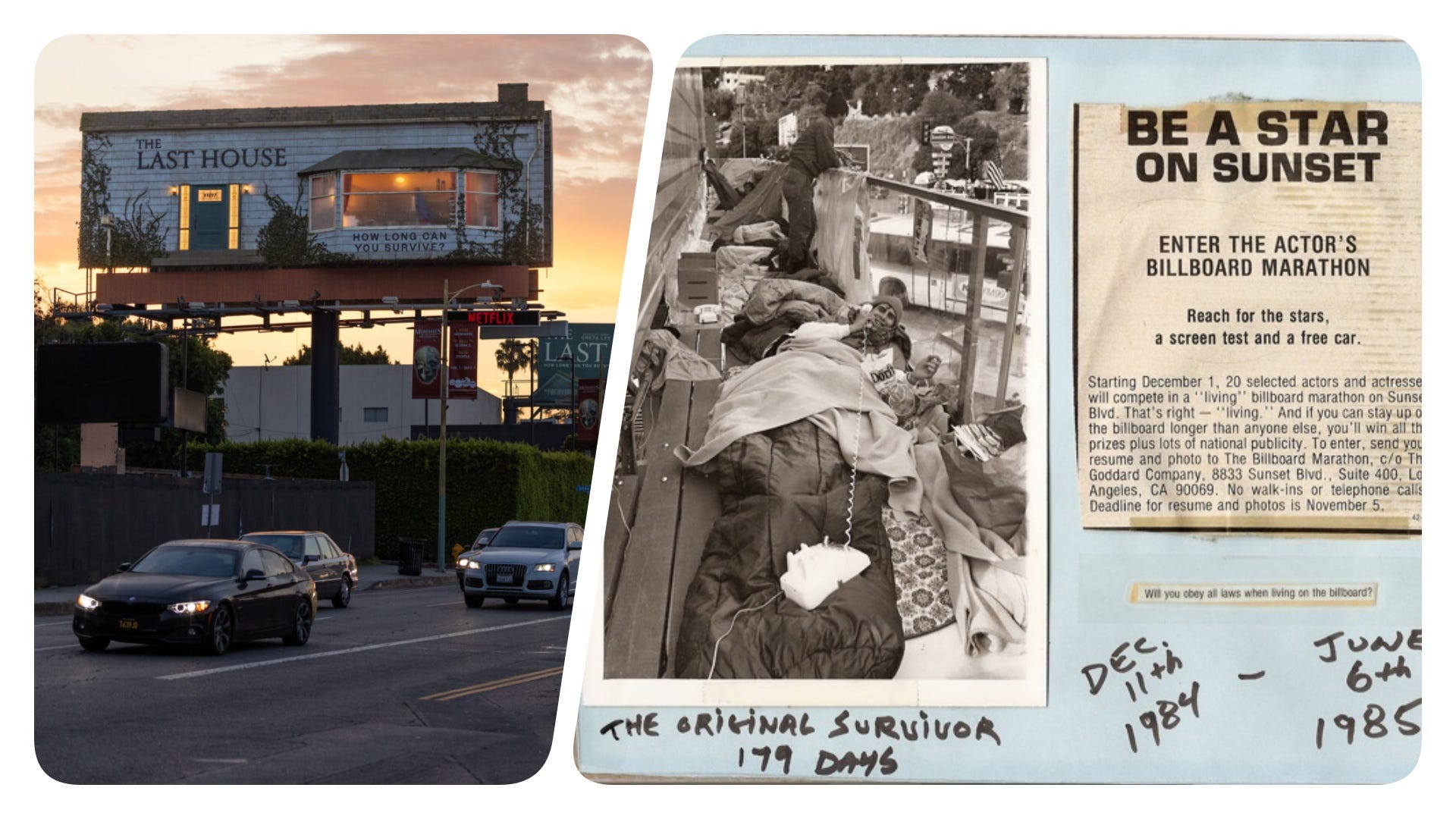
48 Hours? Ha! Living on a billboard is nothing new on Sunset Boulevard. Jeff Olan’s scrapbook features the highs and lows of an actual endurance stunt.
You know what smells? When city planners, paid to represent the interests of Angelenos, produce garbage policy documents that endanger all historic districts, forcing citizens to burn the midnight oil doing their jobs for them.

9th Circuit upholds the Mark Ridley-Thomas bribery conviction. The ruling perforates the entitled arguments of a politician whose harm to the commons includes the vote to let LACMA bridge Wilshire. Hacked Sony emails suggest it was pay-for-play.
We knew Ridley-Thomas was up to no good when we happened to get into the same elevator with him at the Los Angeles Athletic Club shortly after he’d initiated cultural heritage policies for the County, something we’d been advocating for around the giant tamale-shaped building on Whittier Boulevard. So when we recognized him, it seemed natural to exclaim, “Oh! It’s the Preservation Supervisor!” The dude recoiled like he was about to be smacked.

Empty Los Angeles heeds the call from a concerned neighbor alarmed by this mid-century 40-unit RSO apartment complex that is Boarded Up in Los Feliz...But Not Empty Yet!
Happy (?) There Will Come Soft Rains week, Ray Bradbury’s grim vision of a smart home that still serves its radiation-poisoned, cremated California family even after it burns to the ground. Here’s Uzbekfilm’s animated short from 1984.
If Los Angeles had a stronger Cultural Heritage Commission, it would have had the power to compel the property owner to properly secure the Pacific Dining Car before fires reduced the “protected” landmark to ash. Angelenos care about these precious places, even if our “leaders” don’t.
So, who killed the Pacific Dining Car? It was a joint effort, and could never have happened without the property owner and the business owner letting their personal family feud destroy a beloved landmark, Los Angeles City Hall’s failure to enforce code violations, allowing demolition by neglect, bureaucratic inaction and cynically using landmarks for PR purposes while failing to protect them, Councilmember Eunisses Hernandez for her active hostility to historic preservation and refusal to address dangerous conditions around the landmark, former Councilmember Gil Cedillo for his bizarre support of a landmark nomination that the business owner wanted and the property owner opposed, and LADBS inspectors for wrongly closing out code complaints. How can we save Los Angeles when nobody does their job? That’s the challenge, and we want to hear from YOU!

Recommended reading: Enri Marini’s investigation into the players on both sides of LA’s big homelessness lawsuit. It cost him $5000 to get these docs out from PACER’s paywall, so chip in and support independent muckraking and civic transparency.


